

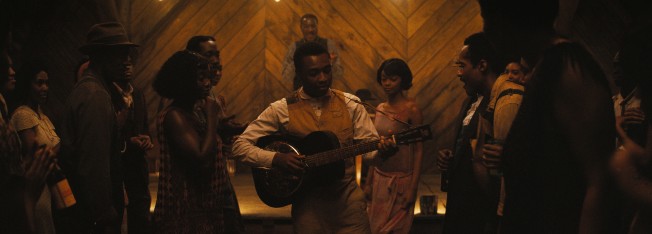
Blending genres such as horror, musical, drama, big-screen spectacle and period piece–the latter slice of history chronicling the racially segregated South during the Jim Crow era–Sinners (Warner Bros. Pictures) in some respects is several movies rolled into one. And that single film has gone on to achieve a cinematic milestone, setting a new record for the most Oscar nominations ever with 16.
This multi-dimensional film inherently posed assorted technical and creative challenges to writer-director Ryan Coogler and the artisans supporting his vision. In SHOOT’s October 2025 Preview to this 16-part The Road To Oscar Series, Autumn Durald Arkapaw, ASC shared that such challenges are easier to take on due to what she described as Coogler’s brilliance in assembling an ensemble of artists and problem solvers who care for one another. “I feel fortunate to make a film like this on that scale with people I consider to be family and friends,” said Durald Arkapaw whose work on Sinners earned her a Best Cinematography Oscar nomination. She noted that Coogler creates this collaborative culture with people who “enjoy making films with each other. People respond to that. Audiences feel that,” she affirmed.
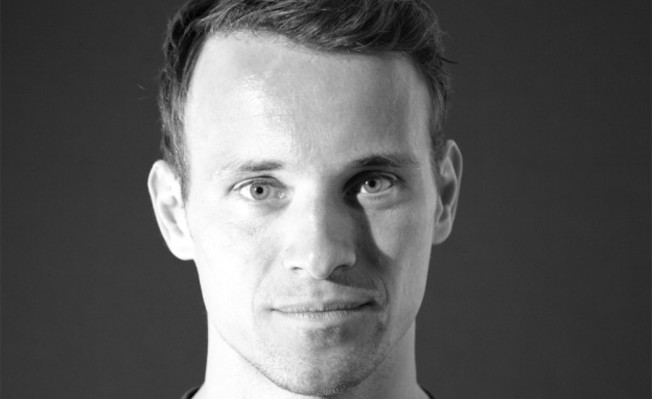
In the case of visual effects, also part of the Academy Award nomination haul for Sinners, that familial feeling was rooted in the bond between visual effects supervisor Michael Ralla and visual effects producer James Alexander. Ralla was already part of Coogler’s cinema family going into Sinners, having served as an additional effects supervisor on Black Panther: Wakanda Forever, which also marked his first time working with Durald Arkapaw. Ralla brought Alexander into the Sinners fold based on their longstanding collaborative relationship, going back to when both were at Framestore’s visual effects studio in Los Angeles.
Ralla shared that his bond with Alexander helped in tackling the storytelling complexities of Sinners. Ralla noted that the visual effects department represents “the biggest below-the-line item you have on a lot of films. We are also one of the very few departments that have the producer and supervisor capacities split” in contrast to other departments like camera, for example, where an individual DP encompasses most everything relative to cinematography–creative, supervision and production. Frequently the motion picture studio hires the effects producer separately from an effects supervisor. This translates into the producer’s loyalty often being to the studio while the supervisor is entrusted with the storytelling in alliance with the director, observed Ralla who noted that this can be “a point of friction” between effect supervisor and producer. It can make a hugely positive difference, he continued, if the supervisor and producer have a track record of working together creatively, that they trust each other. Akin to Coogler’s affinity for making films with friends–artists he trusts and encourages–Ralla had the opportunity to extend that dynamic “straightaway” with Alexander and they in turn brought in visual effects studios they knew they could rely on and were simpatico with–working responsibly within budgets while prioritizing doing full justice to the story and the director’s creative vision. Fitting that bill were artists such as Ralla’s fellow visual effects nominees on Sinners: Espen Nordahl at the helm of Storm Studios in Norway; Guido Wolter, visual effects supervisor, Rising Sun Pictures in Australia; and special effects coordinator Donnie Dean.
Alexander noted that he and Ralla share a special rapport. “We’re battle tested, have been through the process together and are good at giving each other space,” said Alexander of his collaborative relationship with Ralla.
Furthermore, Ralla and Alexander benefited from Coogler’s desire to have them involved throughout the process–from pre-pro to being on set and then in postproduction. Alexander added that he and Ralla shared a residence in New Orleans during production, drove together to and from set each day. That regular commute, noted Alexander, meant that “a pre-brief and a debrief were built into our schedules every day.”
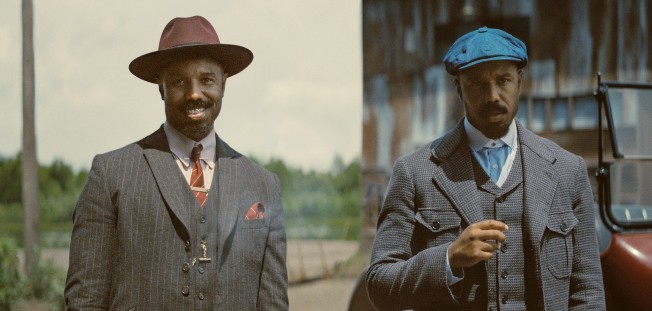
Coogler’s inclusive nature has his collaborators feeling empowered with a viable voice in the process. “Ryan casts people behind the camera just as he does in front of the camera,” observed Ralla, adding that Coogler seeks out colleagues who provide creative input. The writer-director wants and values feedback. “Ryan is always looking to heads of department to bring their experience to the show. It’s not ‘this is the way I want you to do it.’ He’s asking us what we think.” Conversely Ralla and Alexander reversed that process when it came to the “twinning” work in which Michael B. Jordan portrays twins Smoke and Stack in Sinners.
Ralla explained that he and Alexander didn’t want to impose a particular approach or tools on Coogler, instead asking the director that “‘if you had two Michael B. Jordans to film, how would you shoot this?’ We didn’t want any visual effects approach to influence how Ryan was making his film. We wanted to adjust to his vision.” It was “an ebb and flow” of discussion designed to help Coogler “realize his vision completely unencumbered or unrestrained.” This healthy give-and-take can lend itself to the best creative solutions, including in this case the creation of a custom -designed and engineered HALO Rig to accurately capture Jordan’s full head performance for Smoke and Stack on location, with the right lighting and in the very moment of the shoot. This placed the focus squarely on Jordan’s performance and its believability–12x 8K cameras mounted on a body-worn carbon-fiber ring captured a huge amount of data that made full head replacements with exacting precision and aesthetics that stood the test of IMAX scrutiny. Also helping to establish Smoke and Stack as separate individuals was the seamless passing of a cigarette between them in an early scene of the film. This simple act necessitated a complex visual effects solution requiring precise choreography, a techno dolly, a body double, 17 takes and a “pole” marker for the handoff.
The large format lensing of Sinners added to the film’s overall degree of difficulty relative to visual effects. Coogler and Durald Arkapaw decided to mix footage from two different 65mm film formats–from IMAX 15-perf and Panavision 65. This combination allowed the movie to switch between the taller 1.43:1 IMAX aspect ratio and the wider 2.76:1 Ultra Panavision aspect ratio depending on the requirements of a given scene. The IMAX 15-perf film yields a tall, richly detailed frame, necessitating that the effects team mesh old school cinematic techniques, including film workflows from a couple of decades ago, with state-of-the-art technology and pipelines to properly tell the story as Coogler intended.
Sinners became the first feature film shot on 65mm IMAX/Ultra Panavision that exceeded 1,000 visual effects shots–which accounts for more than half of the movie’s runtime. Paradoxically, though, that high volume of effects shots doesn’t translate into Sinners being a visual effects movie. Quite the contrary, as explained by Alexander who observed that the biggest overall challenge posed to him and Ralla was getting “the visual effects integrated seamlessly with the celluloid aesthetic of film.” Even more with a period film, he continued, the effects team had to capture “all the peculiarities and imperfections that make film so magical.” That represented the holy grail in shaping the visual effects for Sinners, “creating digital work that has to be integrated so that it’s invisible in the final picture. That’s the bedrock of all the visual effects work in Sinners.”
Ralla shared that the biggest takeaway or lessons learned from his experience on Sinners included a reaffirmation and rediscovery of his love for celluloid film. Early on, he felt that “from an engineering perspective it didn’t seem to make sense to shoot on film.” But he came to realize that “narratively and emotionally, it absolutely did.” Sinners rekindled his appreciation for the real and tactile properties of film.
Also looming large for Ralla was the power of collaboration within the visual effects department as well as in dovetailing with other departments to get the best end result, working within budgetary confines to give Coogler the solutions and high quality execution he required to tell the story. Again that family feel nurtured by Coogler was felt throughout the departments.
Oscar nominations also reverberated through varied departments. In addition to visual effects and cinematography, the Oscar nominations for Sinners span Best Picture, director, casting, costume design, film editing, makeup & hairstyling, original score, original song (“I Lied To You”), production design and sound, as well as lead actor (Jordan), supporting actor (Delroy Lindo) and supporting actress (Wunmi Mosaku).
Among Alexander’s takeaways was the gratification of being part of a project that has driven audiences to theaters for “that communal experience of watching a movie with strangers in the dark and all the magic that brings.”
On a separate note, Ralla would like to feel gratification in the form of proper recognition for those in his visual effects family–specifically Alexander who made integral contributions to Sinners. Yet in his producer’s capacity, Alexander wasn’t listed as a visual effects Oscar nominee. “There really should be a slot on the ticket for the visual effects producer,” asserted Ralla. “I don’t think four slots [in a nomination] is enough,” given that there are so many [visual effects] people around the world who work on these films.”
Alexander thinks part of the problem is the erroneous perception of the producer as being in a non-creative role. In reality, noted Alexander, the producer’s responsibilities include enabling the creatives, working hand in hand with all the creative partners on the visual effects team to ensure that effects are created effectively and successfully. It’s not possible to separate the visual effects producer from the visual effects process, he affirmed.
Similarly, Ralla believes that the visual effects studios he brings onto a project–headed by invaluable creative talent with whom he and Alexander have a close professional bond–are too often minimized by being referred to as “vendors,” a term which doesn’t do justice to what they contribute to storytelling. Some of these legacy misconceptions have to be overhauled, related Ralla.
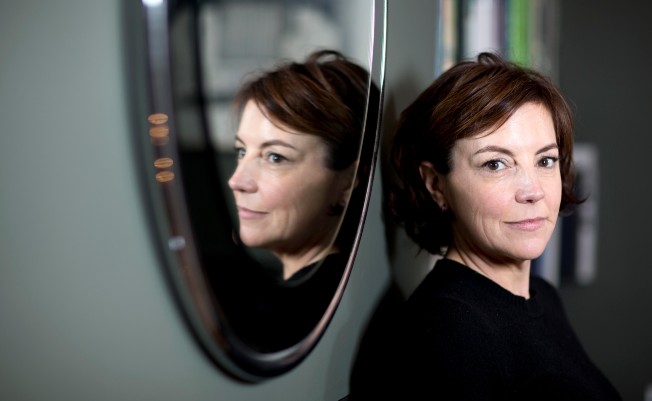
Nina Gold
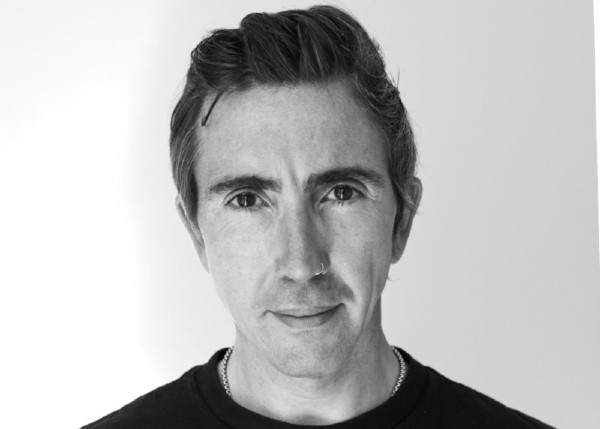
There is hope for realizing reform and a targeted overhaul on the awards show front as reflected in the launch of an Outstanding Achievement in Casting category for the Oscars. Among the inaugural nominees this year is casting director Nina Gold for her work on Hamnet (Focus Features). Gold played an active role in lobbying for the establishment of an Academy Awards category recognizing casting. Many years went into the lobbying effort–spearheaded by the Casting Society (CSA). The first major breakthrough came in 2013 when the Academy of Motion Picture Arts and Sciences established a Casting Directors Branch. Prior to that, noted Gold, casting directors were just part of the Academy as members-at-large.
Shortly after this year’s Oscar nominations were announced last month (1/22), CSA president Destiny Lilly issued a statement which read, “This is the moment Casting Society’s founders dreamed of–one that reflects decades of work to elevate the craft of casting as an essential creative and artistic force in filmmaking. Many of those who helped build CSA have passed on, and we honor their legacy by celebrating this historic, long-awaited milestone for our craft.”
Lilly went on to congratulate Gold and the other inaugural casting director nominees–Gabriel Domingues for The Secret Agent; Francine Maisler for Sinners; Cassandra Kulukundis for One Battle After Another; and Jennifer Venditti for Marty Supreme.
“It’s a complete thrill,” said Gold of her nomination and the creation of the Oscar category. “It feels good and right to be acknowledged by our creative colleagues and peers in the filmmaking world.” She cited the “incredibly hard work” done over the years by CSA and the Casting Directors Branch of the Academy to bring a Best Casting Oscar to fruition.
Hamnet marked the first time Gold had worked with writer-director Chloé Zhao (who also teamed with Affonso Goncalves to edit Hamnet). Gold had wanted to connect with Zhao for some time. “I love her films,” affirmed Gold, citing the writer-director’s The Rider as “one of my favorite films of all time.”
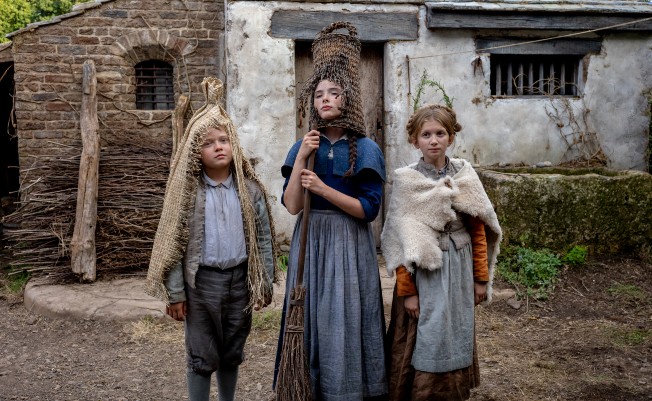
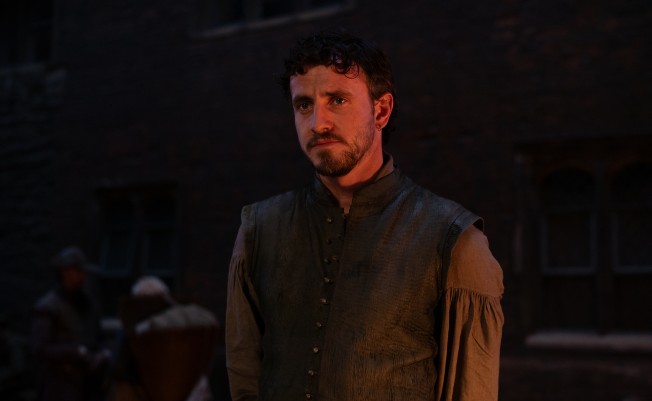
In 2021, Zhao won Best Picture and Director Oscars for Nomadland. Now her Hamnet is up for eight Academy Awards–Best Picture, lead actress (Jessie Buckley), director, adapted screenplay, production design, costume design, original score, and casting. Based on Maggie O’Farrell’s novel (also titled “Hamnet”), the film follows William Shakespeare (portrayed by Paul Mescal) who is in the throes of writing, striving to succeed and making sense of his life. He falls in love with Agnes (Jessie Buckley). They wed but their family is later devastated when their young son, Hamnet (Jacobi Jupe), dies from the plague. The experience of love, loss and deep grief bears, however, a creative silver lining, inspiring Shakespeare to write “Hamlet,” a masterpiece reaffirming the transcendent healing power of theater.
For Gold, the biggest challenge was casting the couple’s children–Bodhi Rae Breathnach as Susanne, Olivia Lynes as Judith, and most importantly Jacobi Jupe as Hamnet. Finding the right actors entailed “an exhaustive search,” said Gold, noting that the roles they had to play would be “demanding for a grownup, let alone a child.”
Gold shared, “I do a lot of casting of children. Every time you realize there’s no shortcut. You have to cover the ground, meet a lot of kids, try them out, get an instinct as to what they’re like.” Plus there’s what Gold described “as a quite rigorous audition process” with the children, particularly when casting a role as pivotal as Hamnet. In his case, the audition involved intense emotional improvisation.
As for the adults, Gold made a conscious effort to “forget” that she was casting the role of Shakespeare. That in and of itself is intimidating. She had to instead make it the casting of “this human man,” with Paul Mescal clearly being a natural fit.
For the role of Agnes, Gold ultimately gravitated to Buckley. The casting director had a history with Buckley. Gold cast her in Taboo when the actor was fresh out of drama school. Later Gold again cast Buckley in Chernobyl. “I’ve been looking at Jessie’s work for years, from the very moment she appeared. I had seen literally everything she’s ever done. I find her to be extraordinary. I had cast her a couple of times before [Hamnet] and both times she was stunningly good, phenomenal as an actress and as a human. She had a real connection to the way that Agnes is.”
Knowing who Agnes and all the characters are up front is essential to Gold doing her job well. And on that front, Gold cited her extensive conversations with Zhao. “We just really delved into it, identifying incredible character detail together, getting to the bottom of who was going to make these characters human.” These conversations, recalled Gold, often took place during long walks together.
“Working on Hamnet,” observed Gold, “exemplifies more than any other film I’ve ever worked on the power of collaboration–and how we all are really doing it together in a connected and organic, trusting-each-other kind of way. That’s what makes it such a good film. It starts with Chloé. She enabled us all–and set us free to do our best.”
Gold’s best has been acknowledged over the years. Her casting has earned BAFTA Film Award nominations for The Two Popes in 2020 and Conclave in 2025. She also has a pair of BAFTA TV Award nods, winning in 2023 for This Is Going to Hurt. Gold additionally has multiple Emmy wins for her casting, spanning John Adams in 2008, The Crown in 2018, Game of Thrones in 2015, 2016 and 2019, and Baby Reindeer in 2024
Gold has amassed 42 career Artios Award nominations from the CSA, including five this year–for the features Hamnet and Jay Kelly, and in television for The Day of the Jackal, Slow Horses and Bad Sisters. She won Artios Awards for The King’s Speech in 2011, My Week With Marilyn in 2012, Game of Thrones in 2016 and 2020, The Crown in 2019, Catherine Called Birdy in 2023, and Conclave, Baby Reindeer and Slow Horses in 2025. Gold additionally won an CSA Zeitgeist Award in 2020 for Star Wars: Episode IX–The Rise of Skywalker.
This is the 15th installment of SHOOT’s 16-part The Road To Oscar Series of feature stories. Shining a light on such disciplines as directing, cinematography, producing, editing, music, production design, costume design, casting, visual effects and animation, this series will appear weekly all the way through to the Academy Awards gala ceremony. The 98th Oscars will be held on Sunday, March 15, at the Dolby Theatre at Ovation Hollywood in Hollywood, Calif., televised live on ABC and streamed on Hulu.