

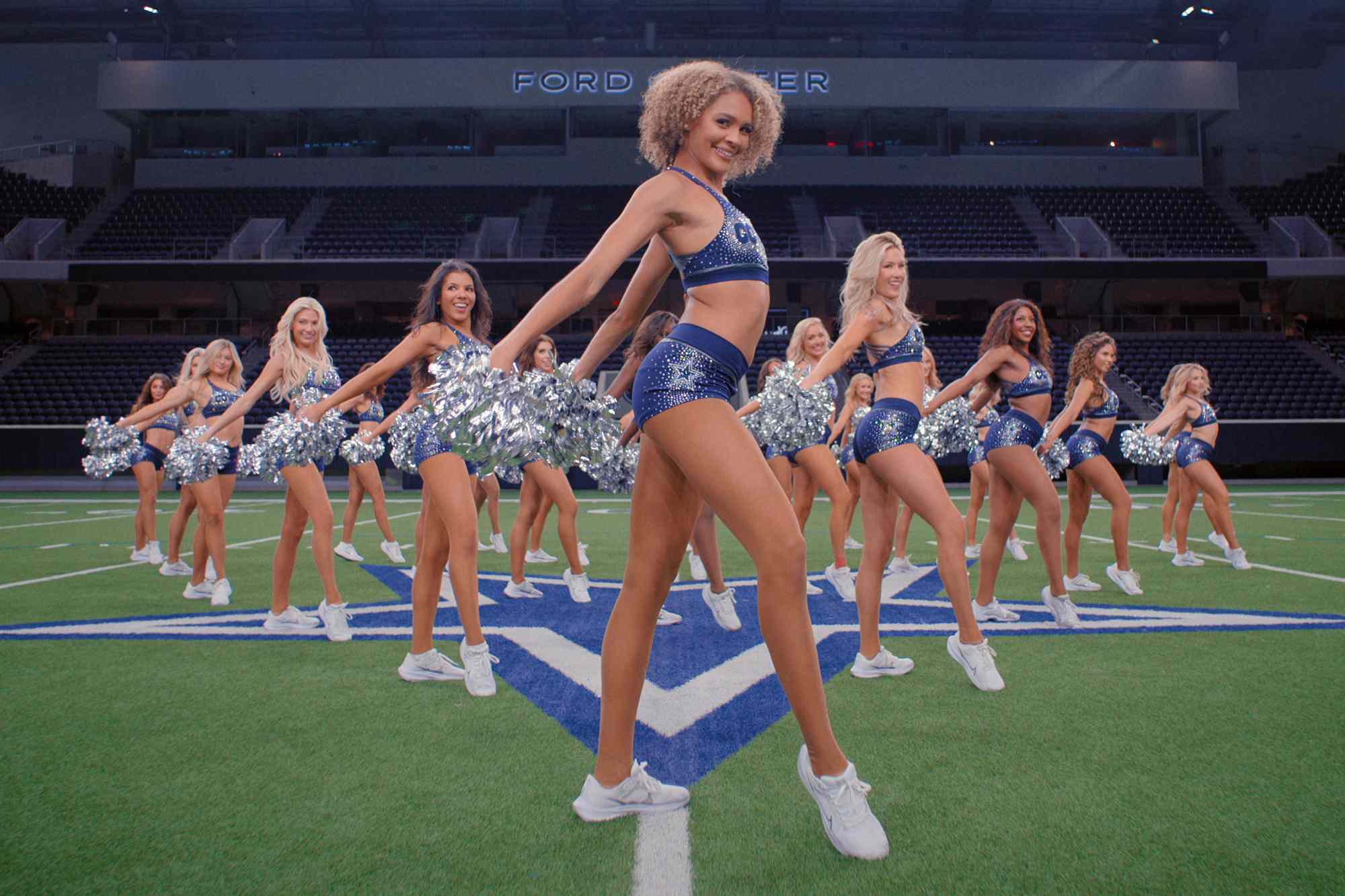
Football may be one of America’s most enduring cultural institutions, but few symbols of the sport have achieved the global recognition of the Dallas Cowboys Cheerleaders. America’s Sweethearts: Dallas Cowboys Cheerleaders pulls back the curtain on the women behind the iconic uniform, giving an intimate look at the real lives of these cheerleaders, the reality behind their practice and preparation, and insight into the machine behind a cultural phenomenon. Now in its third season, editing has always played a key role in the series’ honest look at the world of cheer. We sat down with series editors M. Brennan, ACE; Noah DeBonis; Zachary Fuhrer; and Stefanie Maridueña, ACE, to discuss the pivotal role they play in bringing this story to life.
What drew you to America’s Sweethearts: Dallas Cowboys Cheerleaders?
M. Brennan, ACE: I was drawn to America’s Sweethearts for the chance to work again with such a great team and the opportunity to take a deeper look into such an iconic and legendary team. What surprised me was learning how hard every woman on the team has to work to be part of an institution that they love.
Noah DeBonis: The team behind America’s Sweethearts is really a work family. I’ve been fortunate to collaborate with this group of storytellers across multiple series over the years, so I knew from the outset that it would be an exciting creative challenge. What drew me to the project itself was how unexpectedly layered it was. Most of the shows we’ve worked on together have explored the world of sports, but America’s Sweethearts offered a chance to examine one of the most recognizable sports brands in the world through a much less familiar lens. On the surface, it’s a story about making a cheerleading team, but underneath it are questions about ambition, identity, tradition, performance, and what people are willing to sacrifice in pursuit of something meaningful to them. As a documentary storyteller, those are the kinds of stories I’m always drawn to.
Zachary Fuhrer: As Noah and M. mentioned, it’s always a joy to work with the One Potato family. And after early conversations with our showrunner, Adam Leibowitz, and producer Claire Onderdonk, it was clear that the field team was capturing a rich, character-driven story. I knew of the cheerleaders as an iconic brand, but knew little about their history, their style of dance, or what motivates each dancer to join this ultra-competitive sorority. From day one, this felt like a dynamic world to explore, with the potential to make a new kind of observational documentary. What we kept coming back to was this question of “What do you have to give up of yourself to be part of this team?” and “Is it worth it?” These aren’t questions unique to being a Dallas Cowboys Cheerleader. They’re questions we sometimes forget to ask ourselves when we’re trying to join a club or get a new job. Sometimes you lose a bit of yourself in the process, but perhaps that’s worth it if you gain a community.
Stefanie Maridueña, ACE: Like everyone has mentioned already, we have become a close knit team over the years working together on different shows for One Potato Productions. I love the established work culture that has resulted from this because I’m working with people that I know care about our participants but also each other. I also admire the distinct storytelling approach in our series that prioritizes the human interest stories within the realm of sports. As far as what drew me to America’s Sweethearts specifically, I would say is probably aligned with what made the series such a hit in the first place. We get to explore this decades-old, iconic institution through a present-day lens. The public perception of the Dallas Cowboys Cheerleaders has been one of perfection and beautiful dancers, stripped of their identity. But our show allowed us to pull back the curtain and reveal the layered humanity and how admirable they really are. We are so grateful that they’ve opened up to us in such an honest and vulnerable way to be able to truly represent their stories.
What is your approach to pacing a series like this which alternates between high-energy performances and deeply personal moments?
M. Brennan, ACE: For me, constructing a compelling story is like riding a roller coaster. Balance is essential. High energy performances have more depth and emotional resonance when we know the backstories of the performers. To understand Victoria, it’s essential to know how much she loves DCC and how much it weighs on her with every step.
Noah DeBonis: For me, pacing is about contrast and balance. A high-energy performance sequence can be incredibly exciting, but it only has impact if the audience is also invested in the people performing. Likewise, a quieter, more personal scene often lands harder because of the momentum and energy surrounding it. One of the things I love about America’s Sweethearts is that it naturally contains both ends of that spectrum. You have these large-scale performances and rehearsals, but you also have very intimate moments where someone is dealing with self-doubt, family expectations, rejection, or the pressure they’ve placed on themselves. As editors, we’re always thinking about how those two sides can support one another. The performances may provide the spectacle, but it’s the personal moments that give those performances meaning. When the balance is right, each elevates the other.
Zachary Fuhrer: We talk a lot about soup and sharp edges. When the edit starts to feel soupy, you’ve lost a sense of story or a point of view, and a scene feels detached from its subjects. When the story flows in too dreamy or meditative a fashion, you may not need more narrative connective tissue. You may need a sharp edge. Take a nice hack and shift to a completely different character or narrative thread. We have the luxury of a seven-episode series, where you can plant an idea in episode 2 and, if it’s solid enough and sticks with the viewer, confidently pick it back up in episode 4 or 5.
Did any other docuseries or documentaries serve as inspiration when approaching the edit for this show?
M. Brennan, ACE: As with all One Potato series that I’ve been a part of, the work of legendary documentary filmmakers Frederick Wiseman and Albert and David Maysles is a huge influence. We generally try to follow the same fly-on-the-wall, observational style interspersed with intimate and empathetic interviews. I think everyone on the team relishes having the chance to tell novelistic stories over the course of several episodes. There might be similar elements from year to year, but each season is different and we look to our subjects to tell us where our stories should go; we don’t have an agenda to impose upon our footage.
Zachary Fuhrer: We’re also huge fans of D.A. Pennebaker and, while we mix in some of these more sporty, pop montages, we’re first and foremost grounded in vérité storytelling. That requires an enormous amount of time, patience, and relationship-building in the field, and we’re lucky to have such an empathetic team that puts in countless hours getting to know the cheerleaders, the coaches, and the staff to make sure we’re never shortchanging anyone’s story or simplifying a subject to an archetype to serve a more straightforward narrative.
Beyond that, there’s a ton of humor in this show, and it’s hard not to inject some Christopher Guest in there. The DCCs are super funny, and the coaches, Kelli and Judy, remind me a lot of Laverne and Shirley. With so much story to tell and so many people to follow, it’s important to remember to leave room for laughter.
What footage tends to be the hardest to shape into a scene?
Noah DeBonis: On America’s Sweethearts, we tend to lead with observational footage, but we’re constantly working with a wide range of material: interviews, archival footage, vérité, slow motion, music-driven b-roll, and more. Each type of footage has its own strengths. Observational scenes allow you to sit with a character and experience a moment alongside them, while interviews can communicate ideas, context, or emotion more directly.
The most challenging scenes are often the ones that need to combine all of those tools at once. You might move from a vérité moment to an interview sound bite, then into a music-driven montage, all within the same sequence. The challenge becomes finding a visual and emotional language that makes those transitions feel seamless while still serving the larger story.
A good example is the “9 to 5” montage from Season 1. We were trying to capture an especially grueling stretch of the season. The sequence weaves together observational footage, interviews, archival material, and fast paced b-roll, all with very different energies. The challenge was finding a way to make those disparate elements feel like they belonged to the same emotional experience. Those kinds of sequences can be incredibly difficult to build because there are so many moving parts, but they’re also some of the most rewarding. When everything clicks, you can communicate a tremendous amount of story, character, and emotion very quickly.
How do you navigate the line between respect and critique when editing a documentary series about an iconic institution like the DCC?
M. Brennan, ACE: Documentary editors very much function as writers, but with an inherent responsibility to the people who give themselves over to a documentary filmmaking team. You can’t tell a person’s story properly without understanding and having empathy about where they’re coming from. We take that responsibility very seriously and respect the vulnerability of our subjects, while also wanting to be fair and honest. That’s our guiding light throughout.
Our primary goal is simply to express what it’s like to be these people, to live these lives, to feel what these girls feel. Very often, we are surprised by what happens in the lives of our characters, but it’s not our job to judge; it’s our job to tell their story truthfully with as much kindness as possible.
Zachary Fuhrer: We never had to choose between respect and critique, because the women did both themselves. They love this team, and they questioned it. Our job was just to stay close enough that their questions became the audience’s questions.
What sequence in the series are you most proud of?
Stefanie Maridueña, ACE: It’s hard to pick one sequence in a series like this but one that I really enjoyed editing was the Cold Open in episode 1. For the first half, we wanted to establish the team’s inherent pressures and aspirations for perfection that became a persistent theme throughout the season. To focus this emotion, the first section of the Cold Open leans on the ethereal, dreamy imagery of the Dallas Cowboys Cheerleaders contrasted with bites from our Coach, Kelli Finglass, and cheerleaders talking about this dream and the toll that this perfectionist world can have on one’s identity and mental health. I wanted to ensure that the pacing was slowed down in the edit to match this reflective and introspective moment which was really fun to have disrupted by Jada’s bites about disrupting the status quo and kicks off the high energy supertease to Tom Petty’s “American Girl.” The sequence perfectly encapsulates this emotional journey we see play out during the season and how the women resisted and pushed back against this established culture, especially through their battle for fair compensation. I still get chills when I watch it!
Noah DeBonis: I’ve been lucky to work on some of the larger montage sequences in the show. They can be challenging because you’re often pulling footage from across the entire season and trying to make it feel cohesive while still driving a clear story idea. It becomes a balance of structure and rhythm; figuring out how music, pacing, and visuals all work together. One that stands out from Season 2 is the “Busy Season” montage in Episode 6, where we follow the team through a grueling stretch of performances leading up to the final spectacle at the Jake Paul vs. Mike Tyson fight. It incorporates a lot of voices, action, and overlapping ideas, but the goal was to keep it feeling fun, rhythmic, and propulsive. I’m really proud of how it came out, and it felt like all these wild and distinct ideas we were playing with locked into place.
M. Brennan, ACE: One of my favorite sequences to cut was the opening to Season 1 – the cold open with Victoria’s emotional reaction to practice into the series montage taking us behind the curtain with the team. It set the overall tone for the series and was super fun to cut.
Zachary Fuhrer: In Season 1, I was most proud of the overall architecture of the show. There’s a real satisfaction you feel as a team when themes naturally emerge from the episodes, and every detail feels purposeful and in service of the whole.
During Season 2, seeing Nickel Boys sent me back to RaMell Ross’s photography and documentary work. My friend Dan Timmons mixed both Nickel Boys and RaMell’s brilliant doc Hale County This Morning, This Evening, and it was amazing to learn about every little visual and sonic decision that goes into RaMell’s unique first-person storytelling, which he calls “sentient filmmaking.”
On America’s Sweethearts, we’re never filming from that perspective, but our storytelling shines when we’re locked in on one person’s POV. Late in Season 2, I was given the opportunity to build this cathartic sequence for Armani, one of the team’s veterans and leaders, who we learn early in the season has alopecia and performs with a custom wig that, in a way, helps her blend in with the other DCCs. Over the course of the year, we see Armani and many of the other cheerleaders develop this amazing confidence and sense of self, as they advocate for better compensation and question some of the institutionalized norms in “DCC land,” as they call it.
Toward the end of the year, there’s a “My Cause My Boots” game, where the cheerleaders promote a charity or cause that’s meaningful to them. And to raise awareness for alopecia, Armani performed without her wig.
The first time I saw the footage, I was in awe of Armani’s bravery and knew it was important to stay as close to her as possible, to try our best to represent her experience on that day. Rather than cut around to crowd reactions or overwhelm the edit with interview bites, I opted to jump cut through her performance so it felt like a memory, the way memories often come back as a series of moments. I stayed on her lav throughout and cranked the gain so we could hear every breath, the sound of her pom poms, the echo of “Thunderstruck” reverberating around the stadium, and the celebratory embraces she received from her teammates. I’ll never really know what Armani felt like on that day, but I think it’s important to try.
With any kind of documentary television, there is a big responsibility for the editor in determining the roles certain people end up playing in the overarching story. How do you avoid reducing real people to archetypes like “the veteran,” “the rookie,” or “the underdog”?
Zachary Fuhrer: Greg Whiteley, our director and EP, has always emphasized that it’s important to honor the complexity and individuality of every person who lets us tell their story. Simplifying a person’s experience to an archetype is not only dishonest, it’s not even interesting. Life is messy and twisty and full of contradictions and, yes, that may make it harder to package it up into something that’s neat and tidy and easy to watch, but that’s not real. When we do group cheerleaders together by experience — rookies, veterans, comeback girls — it’s a way into understanding how they might see themselves in relation to this massive Dallas Cowboys organization. When you’re just trying to make the team, it’s easy to overlook things that may be undesirable or not aligned with who you are as a person, because your main goal is to be accepted. The veterans are in a somewhat different position, where the most senior ones are wrangling with what they want their contribution to the team’s storied history to be. And that became the season’s biggest storyline: the veterans deciding to push for real change within the organization. We didn’t impose it, it just happened.
Stefanie Maridueña, ACE: Additionally, we want the audience to connect with our subjects and their experiences. The only way to do this is to deeply explore and understand what motivates the cheerleaders and coaches and how these aspirations influence their behavior. It’s not easy to nail this when we are dealing with complex characters, as you would expect with any human. It’s a very meticulous, months-long process in the edit that asks, “what are the best ways to introduce information about someone to the audience and when are the best times to peel back the layers of who they are and where this takes us?” We build our character arcs through different approaches and see what lands with the most honest interpretation of who they are but also delivers the best emotional impact for our audience. Ultimately, we want viewers to relate to our subjects and become invested in their outcomes. I feel that editing is also a very empathetic job and our entire team is reflective of this as we all deeply care about the people we platform and how they will be perceived by the public.
What do you think viewers misunderstand most about the editing process in documentary television?
Zachary Fuhrer: The biggest misconception might be that we know what the show is before we make it. We genuinely have no idea who we’ll be following or what the season will look like until we’re deep in the edit. I imagine it’s easier to get a show greenlit if you can articulate the structure, the characters, and the ending before you set out on your first shoot. But that’s not how we work. Editing a show like America’s Sweethearts, with 100-plus days of rich observational footage to work through, along with interviews and gorgeous specialty shoots, requires a lot of patience, and a lot of time spent just trying to understand what the material is telling you.
Greg, Adam, Claire, Zoe Lyrintzis, and the entire production and post-production team are immensely talented storytellers who have been crafting these present-tense, character-driven documentary series since Last Chance U and Cheer. And regardless of past successes, Greg and our producers insist that we approach each season with fresh eyes. We’re lucky to work on this show. I wish more filmmakers were given the opportunity to shoot for 100 days and truly embed themselves in the worlds they’re capturing. And we’re fortunate to collaborate closely with a team of smart, creative executives at Netflix who always make us feel like we’re all pulling on the same rope.
Stefanie Maridueña, ACE: I love this question because there is a misconception that reduces editors to the creators of flashy montages with fast cuts and energetic music. In reality, we are storytellers and writers in the process of creating everything that you see on TV and film. We’re not just putting together clips and audio into a sequence. We are actually building the story and having conversations with our directors and producers about how best to represent the vision of the show. It’s much more involved and driven by our understanding of the human experience and the hope is to successfully evoke emotions for our audience while accurately representing the perspective of the subjects in our work. On that note, I want to take this moment to shout out the rest of the amazing editors on America’s Sweethearts whose contributions also elevated the docu-series: Kate Hackett, ACE, Sharon Weaver, Susie Maridueña-Barrett, Deijah Lee-Carroll, Helen Yum and James Atkinson.
What did you ultimately identify as the central story of this season during the editing process, and did it surprise you?
Stefanie Maridueña, ACE: This season heavily centers the story of the Dallas Cowboys Cheerleaders around the varying pressures that they face and how much of that stems from the organization’s established norms. What was really fascinating was seeing how the women pushed back and made a concerted effort to advocate for themselves in a space where, historically, speaking up was not only frowned upon, but punished. This tension was fascinating to explore during the season, particularly through Jada’s fearless and rebellious personality, as well as Armani and Megan, who were constantly finding ways to challenge the status quo. The pinnacle of this dynamic emerges when the squad decides to fight for fair pay and a compensation package that better reflects the value that they bring to the team. After seeing everything else the women do in their day to day lives and how driven and dedicated they are, it was not at all surprising to see them engage in this effort. It was an honor and an inspiration to be able to document their successful fight.
–
Check out more of their work at stefmariduena.com, zacharyfuhrer.com, noahdebonis.com, and mbrennanedit.com.