

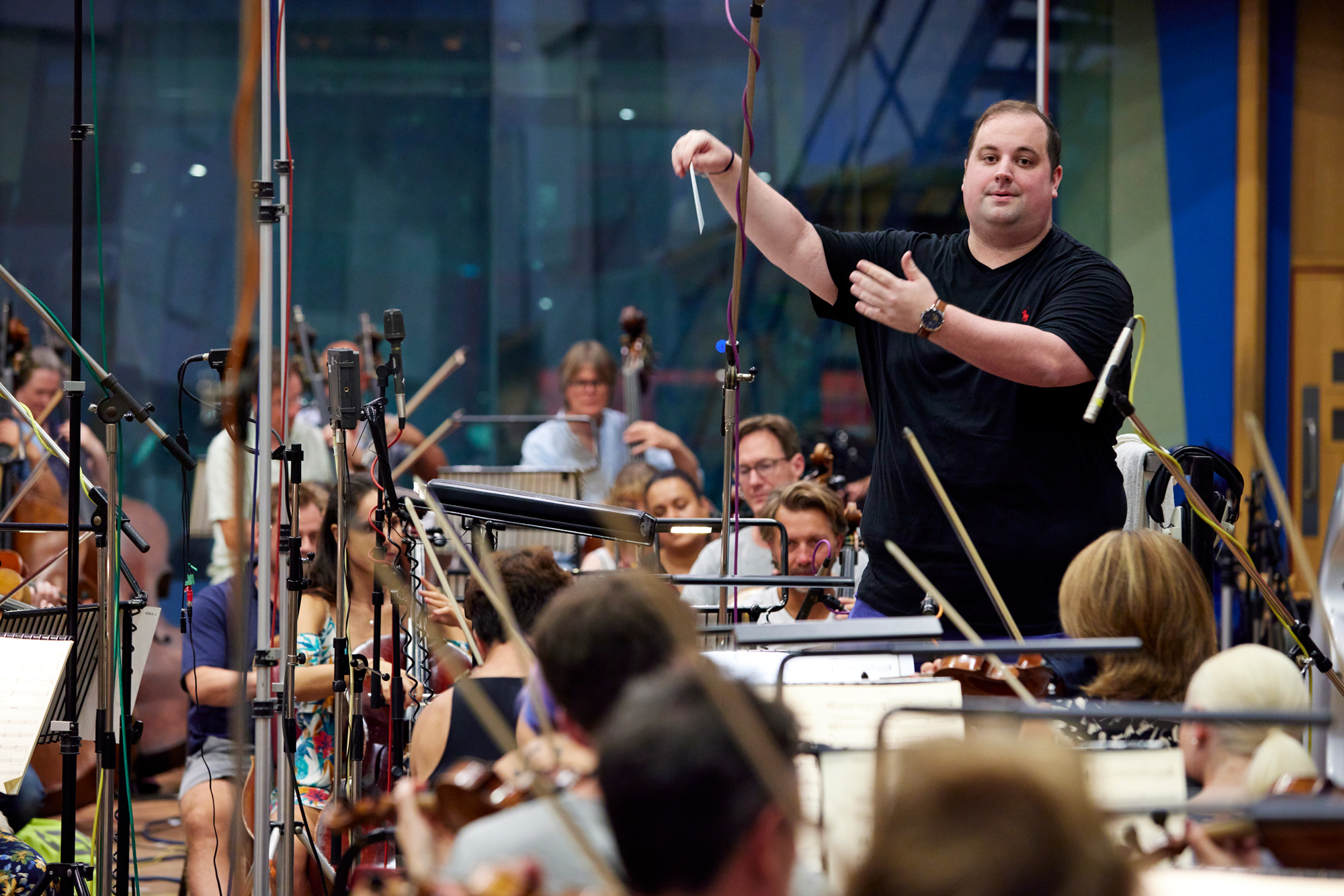
Composer, orchestrator and conductor Vincent Oppido brings a sweeping cinematic sensibility to the upcoming “Magic: The Gathering,” Strixhaven trailer, recorded with an 85-piece orchestra at Sony Pictures Studios. With credits spanning major franchises like Star Wars, Indiana Jones, and Cobra Kai, Oppido blends classical craft with modern storytelling. In this interview, he discusses shaping Strixhaven’s musical world, collaborating with large ensembles, and refining a voice rooted in melody, harmony, and orchestral color.
You composed, orchestrated and conducted the score for the upcoming Strixhaven cinematic trailer for Magic: The Gathering. How did you approach translating the world of Strixhaven into a distinct musical identity?
Strixhaven is a School of Mages that consists of 5 different colleges – all with their own unique personality. My approach was to write something whimsical, but also slightly dangerous. The students have failed an exam and to rectify their grade, they are given a difficult task by their professor – to catch a creature that’s wreaking havoc in the Mystical Archives. Throughout this chase, the students are attempting to capture this creature using their magic. A chase scene is always a great opportunity for a composer because it becomes sort of a ballet. You have a mix of comedic moments and moments requiring a musical gesture. The approach was to compose a piece of music that acknowledges all these visual moments while feeling like a stand-alone piece of music. Ultimately, it’s scoring the drama and the story, rather than scoring every movement on the screen. The best sonic vehicle for something like this is the symphony orchestra – particularly the Hollywood Studio Orchestra in Los Angeles. We recorded the score at Sony Studios with an 85-piece orchestra that was contracted by Gina Zimmitti. And I must say, their incredible musicianship made the cinematic jump right off the big screen!
You conducted the recording session yourself. How does conducting your own music shape the final performance compared to working with another conductor?
We sometimes forget that performance is just as important as the process of composing the music. When considering the amount of time one spends creating the melodic material and then quilting the score with its form and orchestration, there’s no other person as familiar with the score than yourself! Taking a step further, as a composer and conductor, I will sometimes conduct the music differently than how I conceived the performance at the piano. It’s a beautiful give and take between the composition and our most important collaborator in the process, the orchestra. Eighty-five musicians who each bring their own musical personality to create a sound that is mighty. You may even adjust phrasing based on a perspective the musicians are presenting in their playing. It’s a wonderful collaborative process. And being that I am also a conductor, it gives me a chance to shape the music into the best performance it can be.
Your past work includes contributions to major franchises such as Fortnite and the Star Wars universe. Did any lessons from those large-scale projects inform your creative process for Strixhaven?
I’ve worked with our director Al’n Duong on a few of these now and it’s been a rich collaboration. Al’n has a keen ear and is open to experimenting with how we can take the music to an effective level which will elevate the cinematic. When I composed additional music for Star Wars Jedi: Fallen Order, as an example, it challenged me as a composer to write effectively at a quick pace. Those kinds of games have a great deal of action music which meant there were days I would have to compose 2 minutes of fully orchestrated (and by fully, we’re talking about a 90+ piece orchestra and choir) fast-paced music. Your only option in a scenario like that is to be good and to trust your taste and instincts. Also, having the London musicians at Abbey Road is not a bad sandbox to play in!
You’ve worked extensively as an orchestrator on major productions including Elio and Cobra Kai. How does orchestrating for other composers influence the way you approach your own original scores?
I enjoy orchestration very much because it allows me to concentrate and further explore the depths of the orchestra without the responsibility of also having to “create” the music. I’ve been fortunate to work with some wonderful composers who understand the boundless possibilities of an orchestra while trusting me to create the best representation of the music they have created. It’s all about finesse and understanding how just the slightest addition of an instrumental color can elevate the form of the composers’ intention. I find myself at times thinking “ok, I’ll remember this color for the next piece I compose!”
Your concert works, such as a collaboration with Neil deGrasse Tyson, often explore expansive thematic ideas. Do you find that your concert hall writing informs your scoring voice?
Oh, absolutely! At the end of the day, it’s the same task of composing and orchestrating. What’s different about writing concert music is that you don’t have the other sound elements of dialogue and sound effects to consider. This allows you to explore the full scope of the ensemble for which you’re writing. Having said that, there is an advantage to composing for a visual. In these instances, the duration, form and style are already dictated. So, it’s a give and take between the two art forms. I always feel more informed as a musician when I’ve written a concert piece and then return to write something for a film or video game. You can chalk it up to filling the toolbox with more accessories! What’s interesting about the work you mention, “The Cosmic Perspective,” which is the piece I composed with Neil deGrasse Tyson, is that it is for narrator and wind symphony. In a sense, there is “dialogue” but I treat it as a solo instrument. Incidentally we recorded this work with The United States Air Force Band of the West and is due to release on streaming platforms in the coming weeks!
With the trailer releasing online on March 31, 2026, what do you hope audiences feel when they first experience the music paired with the visuals?
To begin with, the trailer looks stunning. As I said, I’ve worked on a few of these over the last couple of years and although they were all great, this is the best one they’ve created. The vision of Al’n and his fellow creatives is beautifully displayed through the performances of the voice over actors and Blur’s animation. And I hope that the added element of the score will elevate this trailer into something that will excite the fans!
Looking ahead, how does this project represent your evolving voice as both a composer and orchestrator working at the highest levels of cinematic storytelling?
I became a composer because of a need to tell stories through music. And what’s fascinating about our art form is there are so many ways in which someone can tell a musical story. We have such diversity in instruments, people’s life experiences, people’s taste in music – and all the various styles of music throughout the world, that it’s quite difficult to have a voice in a noisy world. For me, I love to tell a musical story through melody, harmony and orchestration. My favorite composers such as Beethoven, Ravel, and John Williams – and artists such as The Beatles, Stevie Wonder and Charlie Puth – have all touched us through these musical elements. Working on a project like Magic: The Gathering has allowed me to express myself through these musical elements in the same way that these composers and artists inspired me. And I certainly hope it leads to more opportunities to share my music with others.