


One cinematographer reunited with director Josh Safdie on a movie which is generating Oscar buzz, including for its marquee performance by Timothée Chalamet.
Another DP continued a collaborative bond with a lauded director that goes back nearly 25 years, back when they were at film school together. Their latest teaming is on the much anticipated sequel to a blockbuster hit.
Our third cinematographer took on his second feature with writer-director Clint Bentley, again gaining awards season traction.
And our next DP reteamed with director Paul Greengrass on a film steeped in daunting challenges, dramatizing a real-life rescue story during one of the deadliest wildfires in U.S. history.
Here are insights from lensers Darius Khondji, ASC, AFC on Marty Supreme (A24); Alice Brooks, ASC on Wicked: For Good (Universal Pictures); Adolpho Veloso, ABC, AIP on Train Dreams (Netflix); and Pål Ulvik Rokseth, FNF on The Lost Bus (Apple Original Films):
Darius Khondji, ASC, AFC
A two-time Best Cinematography Oscar nominee for director Alan Parker’s Evita in 1997 and Alejandro G. Iñárritu’s Bardo: False Chronicle of a Handful of Truths in 2023, Khondji now finds himself once again in the awards season conversation, having made the Cinematography Oscar shortlist last month for Marty Supreme (A24), the DP’s second feature with writer-director Josh Safdie (the first being the 2019 release Uncut Gems helmed by Josh and Benny Safdie).
Khondji has developed a close-knit collaborative relationship with Josh Safdie, dating back to a Jay-Z music video he shot for the director–which led to their working together on Uncut Gems. For their feature reunion on Marty Supreme, Khondji first met with Safdie at a point when he was writing the screenplay. Over time, Khondji saw first hand how Safdie and Ronald Bronstein’s script kept getting better, an evolution which brought the cinematographer deeper and deeper into the story–in concert with assorted other talented artisans, including production designer Jack Fisk, a three-time Oscar nominee (There Will Be Blood, The Revenant, Killers of the Flower Moon). Fisk created environments in which the story and characters could flourish–facilitating camera movement and creative lighting so that Khondji could best capture actor performances and surroundings.
Marty Supreme introduces us to Marty Mauser (Chalamet), a young man working at his uncle’s New York City shoe store. He’s a great salesman but is driven to escape this mundane life by getting his due as a world-class athlete–the sport being professional table tennis. Brash and doggedly determined, the character is loosely based on the real life of champion ping pong player Marty Reisman.
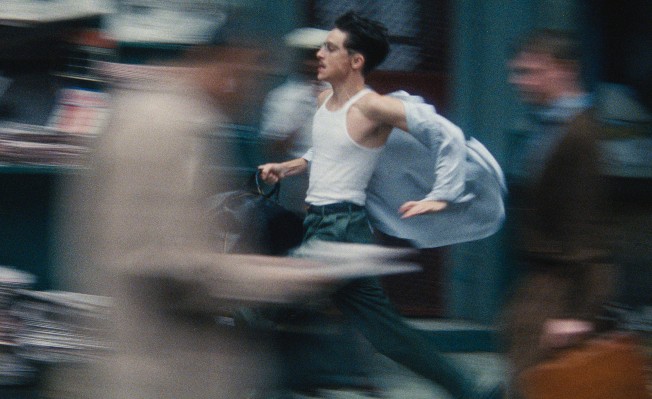
Much of the film takes us to New York in the 1950s. We’re thrust into a frenetic journey through The Big Apple as well as the countryside–and while we’re in the ‘50s, there are modern sensibilities that help make the characters even more relatable, many of them portrayed by non-actors. It’s a hyper-kinetic tale with some 100 locations, often following Chalamet in character running through the streets of New York and other environs. Still, the characters are grounded in their surroundings. Fisk and set decorator Adam Willis (also Oscar-nominated for Killers of the Flower Moon) created settings, said Khondji, that advanced the story and its characters. They built the shoe store, a venue so real that the actors “felt it was home…a place that really existed in 1952,” assessed Khondji who worked closely with the production designer and set decorator to fashion not only that workplace but other sites that felt like lived-in spaces–including some of the tenement buildings with different layers to them that lights could bounce off of, all so that audiences “could feel what they see in the film.”
Khondji said that Fisk still remains very much the “same great artist” who early in his career served as art director on Terrence Malick’s Badlands and then transitioned to production designer on a slew of highly ambitious films. Fisk, related Khondji, is always open to ideas, willing to talk about reflections of light on the set and how they can positively impact the cinematography, how colors translate in dark environments and so on. This dovetails nicely with Josh Safdie who’s “very elegant in his own way” as he envisions the look of a movie, continued Khondji, citing the painterly qualities of shooting on film, which the director has embraced. “I’ve done a modern story with Josh [Uncut Gems] and now a period film in a modern way.” Khondji added that he learned a lot from Safdie’s deployment of music and sound to give a more modern feel to a period piece. Images are created and can be influenced by the flow of music and sound. On that front, composer Daniel Lopatin, who also worked on Uncut Gems, figured prominently. On the strength of Marty Supreme, Lopatin recently earned a Best Score nomination from the Critics Choice Awards.
Another trusted collaborator of Khondji is colorist Yvan Lucas of Company 3. Their track record goes back to the first short lensed by Khondji and through to feature films. Having an aversion to over-processed digital grading, Khondji observed that Lucas’ work brings a natural feel to scenes, making them all the more relatable to viewers.
Khondji primarily deployed ARRIFLEX film cameras and Panavision C and B Series anamorphic lenses on Marty Supreme, often following faces, telling the story through the characters’ faces. Without giving away the end of the film, Khondji observed that Marty Supreme is “for me, very close to life.” The movie conveys the feeling of life through these characters and places, relating the story and journey of a man who is bold, has a big ego but discovers humility. He searches for himself “and at the end discovers life coming to him.”
The cast also includes Gwyneth Paltrow, Odessa A’zion, Abel Ferrara and Fran Drescher.
Khondji affirmed that Marty Supreme is meant for the big cinema screen. To see it on a computer or TV screen carries far less impact, the DP contended, noting that he attended 70mm film and 4K DCP screenings in theaters to gauge audience reactions. Additionally to see such a comedy-drama-sports feature as part of a large theater audience is totally different than the in-home or mobile experience. The shared theater experience significantly enhances the wild ride that Marty Supreme takes you on–emotionally, physically and on a human level.
Khondji, who won the International Award from the ASC in 2023, has four career ASC Award nominations–for Se7en in 1996, Evita in ‘97, The Immigrant in 2015, and Bardo: False Chronicle of a Handful of Truths in 2023. The cinematographer’s filmography also includes such credits as Delicatessen, The Beach, Amour, Okja, Midnight in Paris, Eddington and Mickey 17. The latter two–directed by Ari Aster and Bong Joon Ho, respectively–were released last year; coupled with Marty Supreme, they made 2025 a banner year for Khondji.
Alice Brooks, ASC
While Khondji and Josh Safdie have a shared history, it is hardly as extensive as that between Brooks and director Jon M. Chu. Their collaborative bond began back at USC cinema school nearly 25 years ago when Brooks shot Chu’s thesis film, the musical short When the Kids Are Away. From the outset, they also shared a love of musicals, though studios weren’t making them at the time. Still, they harbored the hope that some day they could come together on a musical in the real world. And after a stretch apart following film school, Chu and Brooks reunited for The Legion of Extraordinary Dancers, a breakthrough web reality series in which dance became a battleground between good and evil.
Brooks’ next project with Chu also had a rich undercurrent of music as they adapted the 1980s’ animated series Jem and the Holograms for the big screen. The live-action feature centered on a small-town singer/songwriter who makes it big but at a personal cost. She and her three sisters are made over, coached and managed into stardom as a band. Their real identities remain secret as the strain of celebrity sets in and adversely impacts family ties.
After a departure from music and dance which saw Brooks and Chu team on the Apple TV+ series Home Before Dark, the two colleagues returned to their musical roots by taking on In the Heights, a feature based on the stage musical of the same name by Quiara Alegria Hudes and Lin-Manuel Miranda. In the Heights featured 17 musical numbers.
Based on their positive experience together on In the Heights, Miranda then selected Brooks to shoot his feature directorial debut, tick, tick…Boom!–a musical about a musical, paying tribute to the late, great “Rent” creator Jonathan Larson.
Then another Broadway hit, “Wicked,” had to be translated from stage to screen–a golden opportunity which director Chu afforded his trusted colleague, Brooks. And while that adaptation entails music, cinematography, a mesh of art and technology, the emphasis during extensive prep time, Brooks told SHOOT in 2024, was “emotion.” That’s what she and Chu are constantly discussing–”yearning,” “loneliness,” “passion,” “power” and “friendship.” Those one-word descriptions, continued Brooks, became “my road map,” a navigation that is all the more essential when shooting two films simultaneously–a scene from Part 1 of Wicked followed by a scene from Part 2, Wicked: For Good (Universal Pictures), for example. Knowing where she is supposed to be emotionally for each scene, said Brooks, proved invaluable. “From that emotion I can create anything.” It’s as if Brooks is an actor. She observed that Chu talks to her as if the camera were an actor. He gives the camera an intention which she in turn shares with her crew, helping to put them on the same storytelling page.
Fast forward to today and Brooks shared with SHOOT the words Chu selected to reflect what was happening in Wicked: For Good, including “surrender,” “sacrifice,” “seclusion” and “consequences.” Whereas the first movie was a fairytale, the second was about what happens after the fairytale. In a sense it becomes clear that the fairytale wasn’t entirely real and has been broken. The first Wicked had the characters making choices. Wicked: For Good, she continued, deals with the consequences of those choices. This, of course, influenced the imagery. There was a glow, an effervescent light, a dream-all-day exterior to the first movie. Much of the second film takes place at night or in the shadows and introduces us to the secret places of Oz.
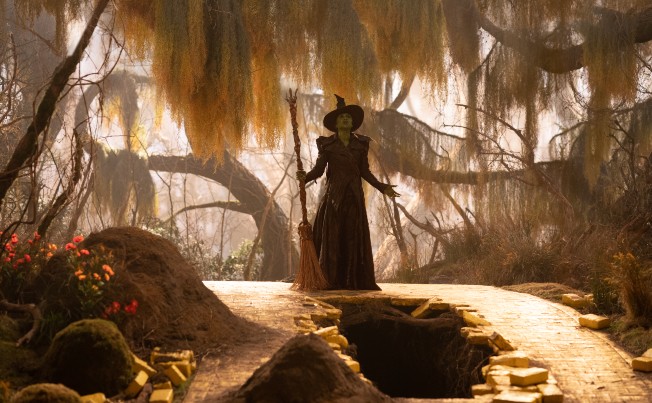
One such secret place is the lair of Elphaba, aka the so-called “Wicked Witch” (Cynthia Erivo), whose friendship with Glinda, the “Good Witch” (Ariana Grande), is put to the test. The lair or hiding place for the Wicked Witch was ensconced in the forest. Production designer Nathan Crowley (an Oscar winner for Wicked) and his team literally wove a nest of wood, greens and shrubs to create a fortress to behold. There was a sculptural dynamic in the creation of the environment. Like an actual sculpture, the maker doesn’t know exactly how it will come out until the creation process leads you to find the form, Crowley explained in an earlier installment of our Road To Oscar Series. With scaffolding and steel construction as a foundation, this literally organic set was an amalgam of beautiful shapes. Windows were woven into an overall set that took some six weeks to assemble–with a mindful eye on story and practicality.
Relative to the practicality, Crowley worked closely with cinematographer Brooks so that she could light the set properly. Towards that end, giant silicone leaves were devised. Adorned with hand-painted veins, these transparent leaves were placed on the roof of the Wicked Witch’s sanctuary, enabling Brooks to cast light into the sculpted setting. Crowley observed that he and his colleagues didn’t know originally where they would end up as they tried to solve the lighting quandary in concert with Brooks. To find that out, they all had to journey there together. “That’s why I love practical filmmaking,” said Crowley, noting that it takes everyone to identify and address issues, problem solve, and fully serve the story and its characters.
Brooks observed that while it may seen logistically challenging to shoot two movies simultaneously, there is a major advantage in that working scenario–namely having continuity among department heads, like her and Crowley, for instance. “We had the entire team together the whole time [for both movies],” said Brooks who added that “the amount we fed off of each other was remarkable.” Usually, if you shoot a sequel down the road after the first film, you invariably wind up with some department heads who are different. But for Wicked and Wicked: For Good, she related, you have people who stayed in London and “lived in the bubble of Oz” for 14 months. This made for a close-knit team and contributed greatly to realizing a key Chu goal, said Brooks, which was to have the Wicked films feel “handmade.”
And everyone had the opportunity to get their hands onto that handmade dynamic, continued Brooks, adding that Chu’s directing approach is akin to “an open forum–he invites everyone to dream bigger than they’ve ever dreamed before. He listens to their ideas and creates this environment that laid the groundwork for both movies. Every person’s love for making this movie is so strong,” she related, and that in turn creates “a level of humanity” which permeates the films.
The Wicked films used the ARRI ALEXA 65 camera. Brooks worked with Panavision to develop special lenses for Wicked: For Good. These lenses have since become what’s known as the Panavision’s Ultra Panatar II line, modern successors to the classic Ultra Panatar series, delivering a vintage anamorphic look. Brooks noted that these lenses facilitated, for example, getting close to Elphaba in a way they didn’t in the first Wicked film, capturing “a rawness and tangibility to her.” And later in the movie, the lens work for Elphaba gets applied to Glinda when she discovers how to find her power and truly be good. “It’s a nod to goodness,” showing, explained Brooks, that Elphaba lives on in Glinda.
In the big picture, Brooks said she’s both surprised and gratified to see how young people have gravitated toward the Wicked movies, “how they see themselves in Elphaba and Glinda.” Brooks said, “As a kid watching the re-release of The Empire Strikes Back, the first movie I remember seeing in the theater, I identified with Luke and Leia.” To now see kids connect with these Wicked characters is especially meaningful. “We live in a time when fear is contagious. This film [Wicked: For Good] is about courage which can be just as contagious as fear.” The Wicked story, concluded Brooks, helps youngsters to “latch onto these courageous characters” and perhaps find “their own power and how they can be brave.”
Brooks earned an ASC Award nomination last year for Wicked and her work on Wicked: For Good just made the Cinematography Oscar shortlist.
Adolpho Veloso, ABC, AIP
Veloso too made the Cinematography Oscar shortlist last month–for director Clint Bentley’s Train Dreams (Netflix). This marks his second feature for Bentley, the first being Jockey for which the DP earned an ASC Award nomination in 2022.
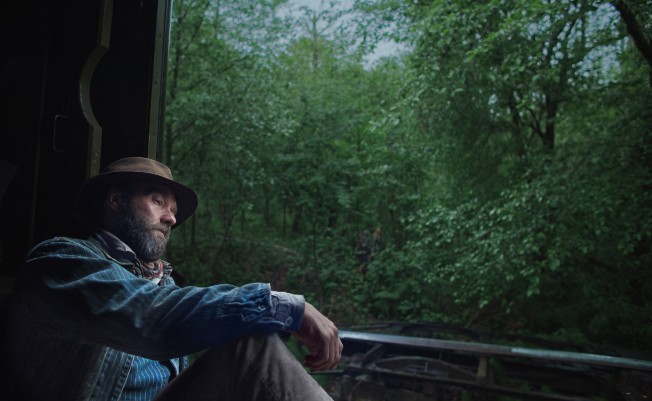
Based on Denis Johnson’s 2011 novella of the same title, Train Dreams is set in early 20th century America and centers on Robert Grainier (Joel Edgerton), an orphaned child who grows up to become a husband and father. He has to leave his wife and daughter for extended stretches of time to make a living as a laborer helping to build a Western railway. One day he witnesses a racist attack on a fellow Chinese worker who’s thrown off a bridge to his death. It leaves an indelible mark on Grainier who’s haunted by the fact that he and other laborers did nothing to save the victim. Part of him believes that he was punished for this years later when his wife (Felicity Jones) and daughter die in a wildfire that hits their home when he is off far away to work on the railway. He bears deep emotional and psychological scars yet somehow perseveres, rebuilding his family’s burned down cabin and living a largely isolated life on the frontier. He still finds beauty in his surroundings, perhaps best exemplified when he meets a new forest ranger (Kerry Condon) and they share a view of the vast landscape from her watchtower. Grainier eventually has an epiphany of sorts towards the end of his life in the 1960s, even experiencing his first ride in an airplane.
Veloso captures the life of Grainier, a major part of which is set against the breathtaking backdrops of the Pacific Northwest. We see both its beauty as well as the all engulfing fire that left behind ravaged land and lives. We also see the grandeur of building railroads in the American West–juxtaposed with the cutting down of trees for that construction.
Among the visual references for Bentley and Veloso in shaping the cinematic language for Train Dreams were the Great Depression-era photographs of Dorothea Lange. “It was so special the way she captured those moments in time,” related Veloso who credited her with reflecting people’s true emotions but without disconnecting them from what was happening. He cited photo compositions which featured faces in the corner of the frame–with the rest of the frame revealing what was happening in their lives. “It was beautiful and amazing how she was able to capture beauty within chaos–something we were trying to do, to show how much the environment affects those characters and how everything is connected.”
Veloso observed that the characters affect those spaces–and those spaces affect them in Train Dreams. Normally epic landscapes are showcased with a wide screen filming format. But Veloso and Bentley instead opted for the 3:20 aspect ratio, an almost box-like frame. Veloso explained that this aspect ratio is most widely associated with what you find in old photographs–or even in more modern terms, the photos stored on a phone. That’s why he and the director found this so appealing–as if taking memories reflected in photographs and piecing together a life through them. “We wanted it to feel like looking through someone’s memories.” It was akin, he noted, to finding someone’s entire life in boxes of photos, bringing a personal feel and some documentary sensibilities to the film.
The cinematographer shared that he was affected by Train Dreams, describing it as a deeply personal movie that underscores the importance of what we have–and that it can be lost at any time. Veloso also identified with the dynamics of Grainier’s life–being away from home for several months to work, meeting people on the job he hadn’t known before, and then having to return home and reconnect.
Veloso deployed the ARRI ALEXA 35 for Train Dreams, citing the camera’s dynamic range, making it easier to rely on natural light. The DP said there was hardly any artificial lighting used. He opted for Kowa Cine Prominar spherical lenses for daytime lensing–mostly because he was drawn to the texture and the way that lens flares with sunlight. Faster Zeiss Super Speed lenses were adopted for nighttime work to capture flames, campfires and real candles.
Thus far Veloso’s work on Train Dreams has earned him a Film Independent Spirit Award nomination for Best Cinematography–and last night (1/4) he won the Critics Choice Award in the cinematography category.
As for what’s next, Veloso recently wrapped a M. Night Shyamalan-directed feature film which is slated to be released towards the end of 2026.
Pål Ulvik Rokseth, FNF
Rokseth too reunited with a director, in this case the Oscar-nominated (United 93) Paul Greengrass, for The Lost Bus (Apple Original Films). Rokseth had previously lensed Greengrass’ 22 July for which the DP earned a Golden Frog nomination at Camerimage in 2018.
While The Lost Bus did not make the Cinematography Oscar shortlist, it was lauded for masterfully dramatizing the real-life story of a school bus driver who picked up 22 elementary school students and their teacher on what turned out to be day one of The Camp Fire. The commute became a lengthy nightmarish ordeal as communications broke down, roads were cut off or gridlocked with congestion, and the flames quickly spread. The Camp Fire turned out to be one of the deadliest wildfires in U.S. history, ravaging the town of Paradise, Calif.
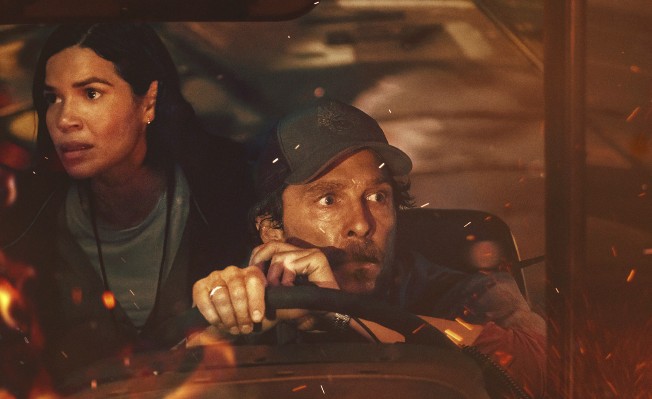
Starring Matthew McConaughey as the bus driver and America Ferrara as the school teacher, The Lost Bus dramatically depicts tragic historic events–shedding light on the driver and teacher’s heroics which miraculously saved all the students. Greengrass teamed with Brad Ingelsby on the script.
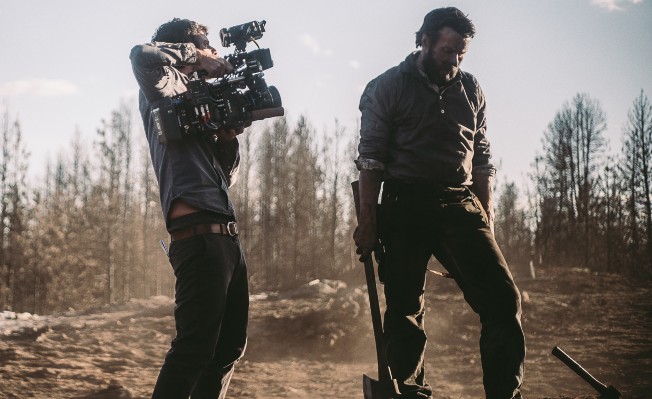
At first, a volume stage and extensive visual effects were to be the means used to attain the fiery hell. But as Greengrass delved more deeply into the story, he felt it could be better told if shot practically. Chronicling the fire, lensing through smoke and ash was more in line with the fluidity of Greengrass’ signature documentary-style. So he and Rokseth abandoned virtual production and set out to carefully and selectively deploy real fire. Production was situated in an abandoned stretch of Santa Fe, New Mexico with enough space to accommodate vehicular traffic; gas lines were laid to burn controllable jets of fire. Tungsten lights had to be deployed to augment the flames, helping the yellowish light emitted from gas burners more closely resemble the warm familiar light that a fire would create.
Rokseth had to re-create lighting conditions that would realistically depict what a wildfire would yield. He shot at and around dusk to resemble an eclipse-like feel where most of daylight is blocked out. Rokseth had to capture not only the terror and chaos of the situation but also the actor performances in an environment, much of which had to be lit by fire for visibility. Sequences were often rehearsed during the day to ensure safe procedures and then shot during a window of time just prior to, during and right after dusk.
The ALEXA 35 was chosen for its great dynamic range, particularly for fire. The camera’s color science rendered the reds of the fire and skin tones with exceptional vibrancy and realism, which helped ground the story emotionally. The ALEXA cameras were paired with various lenses including Canon Super 16 lenses to achieve a handheld documentary style, and Zeiss Master Prime and Angenieux EZ-1 lenses for other sequences.
Leading up to the fire we see that the bus driver, Kevin, was already having a bad day. He had money problems, couldn’t get additional school bus driving duties to earn more income, was taking care of his elderly mother in the months after his estranged father died, and his dog was terminally ill. A fight that morning underscores Kevin’s strained relationship with his teenage son who is stricken with a fever. As he starts noticing plumes of smoke in the distance while driving an empty bus on his way to deliver medicine to his son, Kevin gets a dispatch call on the radio asking if any bus driver is in the vicinity of 22 children who need to be transported to a safe location. Kevin initially waits, hoping that someone else will answer the call but ultimately he responds as his rough morning is about to turn harrowing. Our human portrait of him is about to extend to others–the school teacher and the students for whom she’s responsible, the first responders and a community smack dab in the middle of a disaster that is quickly spiraling out of control. Greengrass and Ingelsby’s script never loses sight of the humanity of the situation–the lives being turned upside down when confronted by crisis–while conveying the unrelenting power of a fire out of control. Rokseth captured the human stories as well as the visceral feel of seemingly being surrounded by growing walls of flame. Greengrass and Rokseth team on this delicate balancing act. There’s even Kevin as a poignant aside having thoughts about absentee fathers and the regret that goes with that–extending even beyond him, his late father and his son. Somehow facing an unthinkable crisis gets one to reprioritize what’s important in their lives–if they are fortunate enough to ever get back to their normal lives.
Rokseth marveled at Greengrass’ commitment and talent to do full justice to what was happening, allowing the camera to be observational as human behavior and a natural disaster unfold before our eyes. Rokseth added that Greengrass at times wanted the crisis to play like a horror sequence–how fear escalates when you’re in the dark, smoke filling the air to the point where visibility is minimal. You simultaneously don’t know what’s around you yet know all too well that you’re in the middle of imminent danger–all the while charged with the safety of children, having to prevent them from being overwhelmed by fear.
From a logistical production standpoint, camera time with the kids was limited. They could only work so many hours a day. Rokseth credited first assistant director Cliff Lanning with brilliant planning and scheduling to make the most of the youngsters’ time on camera.
Integral to the success of the film was Greengrass’ meticulous planning, said Rokseth who noted that the director has a penchant for taking whatever time is needed to do justice to a scene yet always by shooting in an efficient way. Most helpful to Rokseth was that he had prior experience with Greengrass on 22 July. While the challenges inherent in The Lost Bus were staggering, Rokseth had full trust in Greengrass based on their previously working together. “I thought,” recalled Rokseth, “‘that if anyone can do it, it’s Paul.’”
