
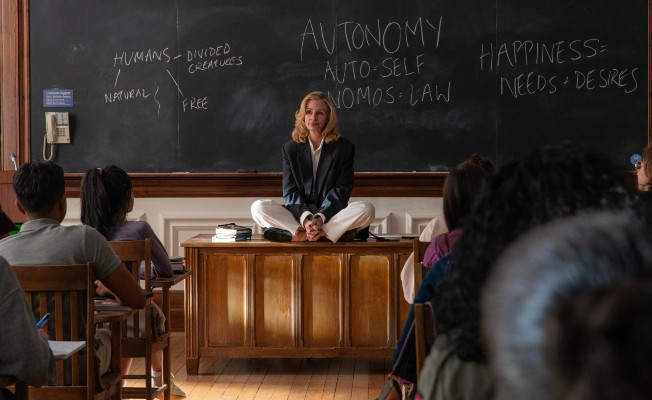

On Monday (Dec. 1) Luca Guadagnino and Julia Roberts are slated to receive the 2025 Gotham Awards Visionary Tribute for After the Hunt (Amazon MGM Studios) at the 35th annual Gotham Film Awards ceremony in New York City. The Gotham Awards Visionary Tribute was created to recognize groundbreaking collaborations that push the boundaries of storytelling in film. Last year’s award was presented to James Mangold and Timothée Chalamet for A Complete Unknown.
Guadagnino previously received the Best Feature award for Call Me by Your Name at the 27th Annual Gotham Film Awards and last year earned a nomination for Challengers. (Call Me by Your Name also garnered Guadagnino a Best Picture Oscar nomination in 2018.) Guadagnino’s filmography additionally includes I Am Love, A Bigger Splash, Suspiria, Bones and All, and Queer.
Among Guadagnino’s collaborators on After the Hunt were: editor Marco Costa with whom he has a track record; and cinematographer Malik Hassan Sayeed, whom the director teamed with for the first time on a feature. SHOOT recently caught up with Costa, and earlier connected with Sayeed on the heels of After the Hunt making its world premiere at the 2025 Venice Film Festival on August 29. After the Hunt went on to kick off the New York Film Festival in late September.
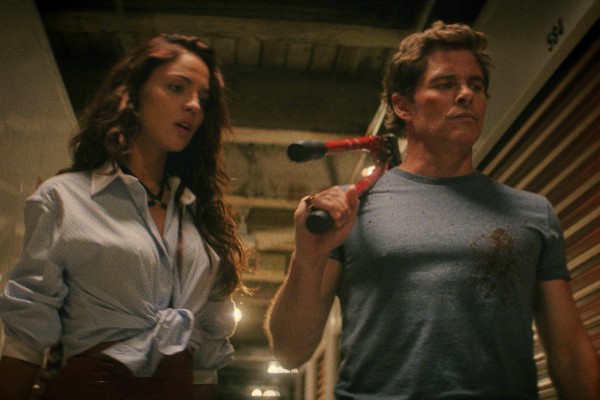
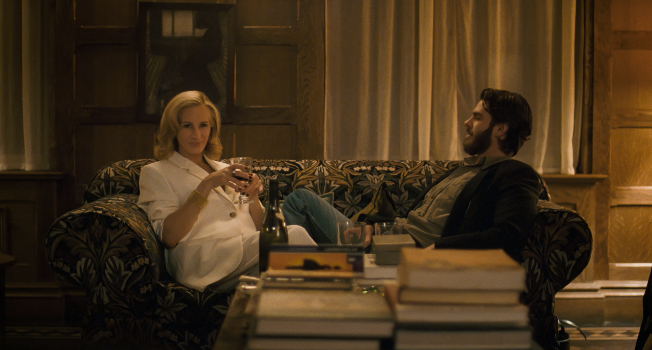
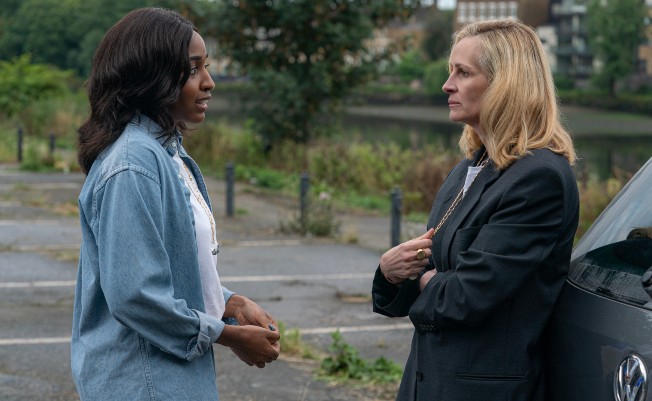
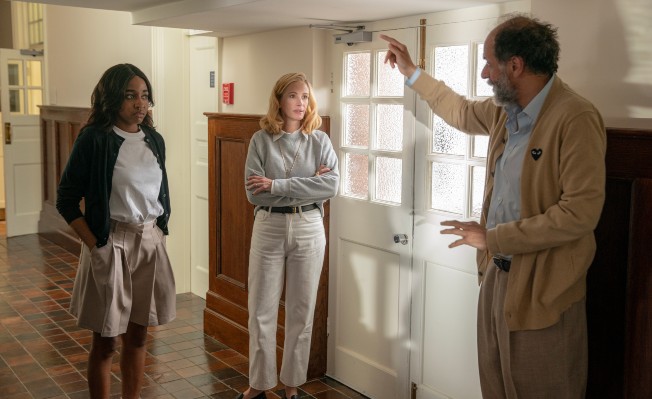
The psychological thriller stars Roberts as a college professor of philosophy who finds herself at a personal and professional crossroads. A star student (portrayed by Ayo Edebiri) accuses the professor’s friend and colleague (Andrew Garfield) of sexual assault. The After the Hunt screenplay by Nora Garrett raises concerns, questions and offers no simple resolutions.
In that vein, Costa noted that Guadagnino wanted an “invisible” edit, rooted in “a neutrality in observing the reality” of the characters, putting the actors’ performances on center stage. “It’s about who’s lying and who’s not lying,” related Costa, making it important for him to “stay longer” on the characters so that viewers don’t feel the editing. Guadagnino did not want the editing to be manipulative, instead leaving the audience to judge. The editing shouldn’t push a moral to the story. It’s almost, observed Costa, that “the less you impose, the more powerful the result can be.”
This distinctive approach to After the Hunt reflects what Costa loves about Guadagnino. “Every project has its own grammar” and affords him the opportunity “to reinvent the [editing] language” in order to do full justice to the story.
There are directors, continued Costa, who make the same movie every time. “Sometimes when you use the same kind of editing in every movie, this can make you lazy–like automation,” said Costa. “That’s not helpful for an editor. Luca always finds a way to stimulate you, to think different for every project….Every time there’s a new way to see the footage, a new approach. It helps me a lot artistically.”
And that artistry has been recognized. For example, Costa was nominated for an ACE Eddie Award last year for his cutting of Challengers, which also earned him Best Editing honors at the 2025 Critics Choice Awards.
Costa first worked with Guadagnino as second assistant editor on Suspiria. Then Costa made the decision to look for smaller projects as a full-fledged editor rather than assisting on higher-profile films. Thankfully, a couple of years after Suspiria, Guadagnino reached out to Costa. As director, producer and showrunner, Guadagnino was looking for an editor to take on We Are Who We Are, a miniseries for HBO. It was a golden opportunity, recalled Costa, noting that the show gave him the chance at an intimate collaboration–just him, a world-class director, and the footage. This led to Costa landing editing duties for the feature films Bones and All, Challengers, and Queer.
Among other highlights for Costa on After the Hunt was the chance to witness Guadagnino working with cinematographer Sayeed. In ways it reminded the editor of his initial collaborations with Guadagnino. “It was fantastic looking at them on the set, how they worked together, to see the cinematography that Malik created,” said Costa, noting that the director and DP conjured up a visual “atmosphere you can feel” as it helped to advance the narrative.
At press time, Costa was editing director Guadagnino’s Artificial, which too was lensed by Sayeed. Another Amazon MGM Studios production, Artificial delves into the controversial firing and rehiring of OpenAI CEO Sam Altman in 2023.
Malik Hassan Sayeed
SHOOT previously chronicled the involvement of Sayeed in After the Hunt. We revisit that coverage now, traced back to Rhea Scott, president and founder of Little Minx, a production company for which she created a collaborative community of filmmakers, often leading to members of the shop’s directorial roster working with and inspiring one another. For example, on occasion director Sayeed hearkened back to his cinematography roots and lensed a select branded content assignment for a fellow director. Such was the case when he shot a Chanel No. 5 project directed by Little Minx colleague Guadagnino.
Scott brought the two together, reasoning that they would mesh and well aware of Guadagnino’s admiration for Sayeed as a cinematographer dating back to his lensing of Spike Lee’s Clockers, He Got Game and The Original Kings of Comedy, as well as second unit shooting duties on Stanley Kubrick’s Eyes Wide Shut. Guadagnino and Sayeed bonded on the aforementioned Chanel job back in the fall of 2023, leading to a pair of collaborations that Scott hadn’t foreseen. Sayeed hadn’t lensed a narrative feature for some 25 years and had no plans to return to such work–-until the opportunity arose to lens director Guadagnino’s After the Hunt.
Following After the Hunt, Sayeed went on to shoot Artificial.
Sayeed, now an established director with notable work in commercials and music videos, was drawn back to feature cinematography by the opportunity to collaborate with Guadagnino. Sayeed recalled that the Chanel job “planted the seed,” adding that “what struck me right away was Luca’s precision with atmosphere. He builds worlds that are tactile and psychological. There was trust from the beginning. Rhea’s instinct in bringing us together was right.”
Sayeed had left narrative feature cinematography in the ‘90s to focus on directing. He related, “I made a promise to myself that if I ever returned to features, the story and collaborators would have to check very specific boxes. After the Hunt did that. The script felt smart, timely and resonant. And Luca’s approach–his mastery of film grammar, his willingness to push away from orthodoxy–aligned with where I was in my life and career.”
Regarding the nature of his collaboration with Guadagnino, Sayeed shared, “We started from texture and pressure. We treated the camera as a witness to everything; sometimes close enough to feel the constriction of a room, sometimes patient enough to let silence itself feel accusatory.
“On a practical level, Luca and I set very specific parameters,” continued Sayeed. “We drew from [director Ingmar] Bergman/[cinematographer Sven] Nykvist, and [cinematographer] Gordon Willis’s work with Woody Allen, and we limited ourselves to light that was authentic to the period. That discipline made a visual language that was both restrained and charged, so the audience could feel the weight of the environment pressing in on the characters.”
Scott noted that After the Hunt is a departure from what one might expect Sayeed to shoot, relating that his cinematography back in the day–such as director Hype Williams’ Belly–was “highly visual.” By contrast, After the Hunt is more “quiet” visually and more dialogue-driven. Scott went to London to visit Guadagnino and Sayeed as they collaborated on After the Hunt, with sets being built at Shepperton Studios. She found Guadagnino and Sayeed “in total flow with each other.” Similarly, Scott witnessed a “deep brotherhood” between the two when she later saw them in Italy and San Francisco on Artificial.
Working in tandem on After the Hunt made for a smooth transition to Artificial as Guadagnino and Sayeed developed a shorthand. Sayeed elaborated that with After the Hunt, “we built a language where every choice had to connect to emotional stakes. Artificial is a different arena. Obviously we won’t copy the look, but we’ve been keeping the discipline.”
And working with Guadagnino has informed Sayeed “completely” as a director. “Directing can make you think in macro terms; shooting this with Luca retrained my ear for the micro…Again, Luca trusts atmosphere to carry psychology. That sharpens my own directing–to let texture equal emotion rather than decoration.”
Sayeed touched upon the lasting impression made on him by Guadagnino. “What stuck with me was Luca’s process. He doesn’t storyboard or come in with everything mapped out. He reacts to the rehearsal, to what’s happening right there in front of him. That means you have to be ready for anything, and I found that incredibly alive.
“Earlier in my career that kind of uncertainty might have been hard for me, but it feels like a gift now. It keeps the work honest. There’s an energy to responding in real time instead of forcing something planned, and that’s what made the experience so invigorating.”
Scott cited some full-circle dynamics as coming into play, recalling when she met Sayeed 27 years ago. “He was working with Kubrick at the time doing second unit. I had to convince him to direct.”
Fast forward to 2024, continued Scott, and “Luca was the one who convinced Malik to shoot a movie again.”
This is the third installment of SHOOT’s 16-part The Road To Oscar Series of feature stories. Shining a light on such disciplines as directing, cinematography, producing, editing, production design, visual effects and animation, this series will appear weekly all the way through to the Academy Awards gala ceremony. Nominations for the 98th Oscars will be announced on Thursday, January 22, 2026. The 98th Oscars will be held on Sunday, March 15, 2026, at the Dolby Theatre at Ovation Hollywood in Hollywood, Calif., televised live on ABC and streamed on Hulu.