

“Home is where the heart is.”
The universality of that time-honored adage is in many respects at the core of Sentimental Value (Neon)–not just as it applies to the story but also as part of the process that went into telling that story.
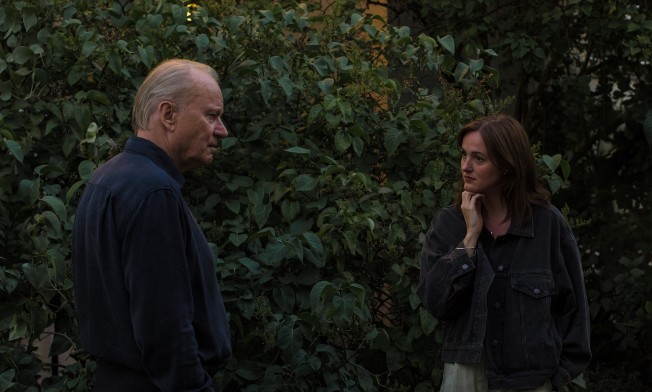
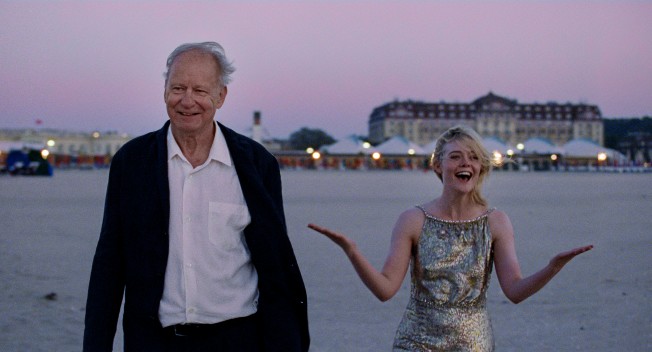
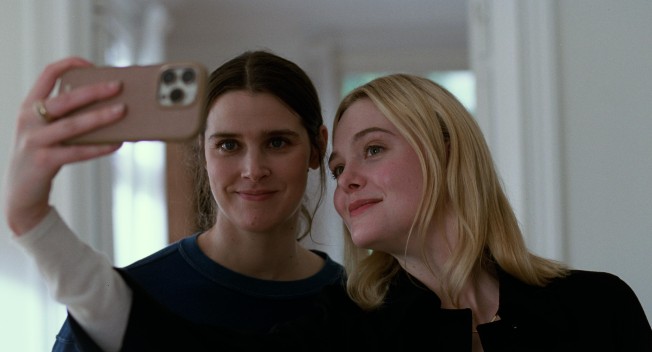
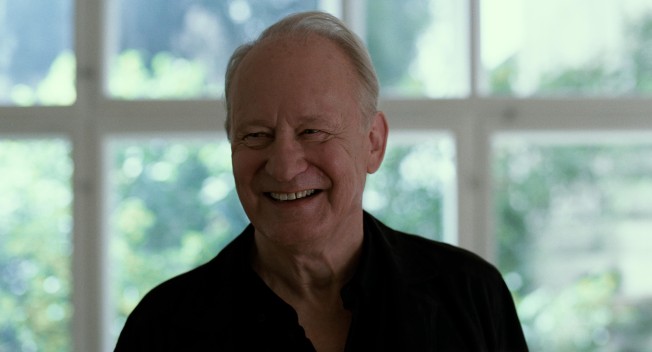
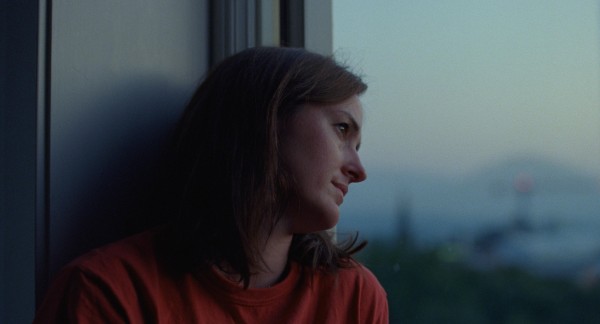
On the former score, director Joachim Trier’s film–which he wrote with long-time friend and colleague Eskil Vogt–is set in an old family home in Oslo that carries memories that help to define two sisters, now adults, and their strained relationship with a father who prioritized his filmmaking career over being a parent. The sisters are Nora (portrayed by Renate Reinsve) and Agnes (Inga Ibsdotter Lilleaas). Nora, the older sister, grew up to be an accomplished actor, following in the cinematic/stage career footsteps of her dad, Gustav (Stellan Skarsgård in a Golden Globe-winning performance). After years of absence from Nora and Agnes’ lives, Gustav unexpectedly appears at the time-worn family residence to attend the funeral wake of the daughters’ mother but his prime motive for turning up is a movie that he wants to make in order to fuel his career comeback. And he has Nora in mind to play the lead in the film. She immediately refuses the role, which ends up going to a movie starlet (Elle Fanning). As shooting begins, psychological scars revert to open wounds and the presence of the American celeb forces Gustav, Nora and Agnes to look at themselves and their family’s fragile emotional underpinnings more closely.
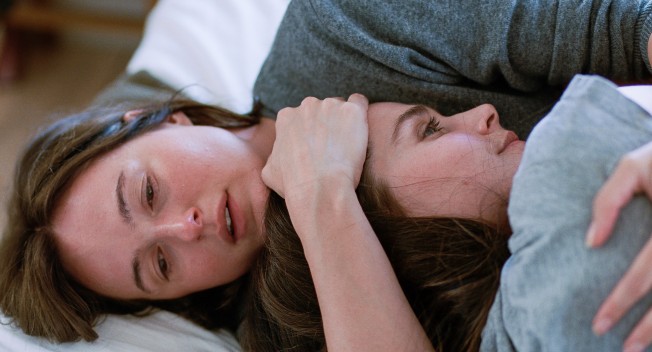
The family home is a repository of past lives spanning love, loss, alienation, joy, resentment and estrangement–as such, it’s a centerpiece for the characters in Sentimental Value and lends great insight into them. For example, at one point around the middle of the film, we see what the home means to Nora and Agnes. The latter is saddened over the prospect of the house going up for sale, confiding in her sister that she dreamt of one day living there with her husband and child. By sharp contrast, Nora cannot believe that Agnes harbors such a wish–thinking that a fulfilling life would be impossible to attain within the confines of a house that was traumatic for her as a youngster. Nora can never look at the home with the nostalgic warmth that Agnes feels.
Trier observed that the home–and that scene in particular–reflects a key dynamic in the drama of the story as Nora and Agnes “have such different experiences” though they are part of the same family. Trier lauded Reinsve’s nuanced performance–conveying that Nora on the surface level is “contemptuous” of the house but at her core has “a deep longing for a sense of home.”
Trier shared that the movie Gustav is making to resurrect his career carries a title that translates into English as “home sickness” or perhaps more accurately into Swedish as “home longing.”
Trier and Vogt longed to find the right home for Sentimental Value. Vogt said that the search was “not like a location scout” but rather “the casting of a house,” adding that while it may sound cliche, the home was truly a character in the story, “such an important part of the film.” They finally found the Norwegian home, a place that “felt right.” They spent time with its owner and learned about his family’s history in the house–and this had the alluded to effect on Trier and Vogt’s writing process. Upon seeing and getting to know the house they had found, Vogt and Trier re-wrote many of the scenes that were to take place there.
Other varied influences helped to shape the writing. Trier recalled, for example, that when he reached out to Kasper Tuxen Andersen about Sentimental Value, the cinematographer was in the midst of lensing a 16mm film for himself about his family, hearkening back to the Copenhagen flat he grew up in. Andersen said he was spurred on by the reality that his parents were getting older. Trier related, “When I told him what I wanted to do next [Sentimental Value], Kasper said ‘that’s the kind of movie I’m making now.’”
Vogt added that the cinematographer sent his 16mm film to him and Trier. Seeing how the DP filmed his parents and their home, said Vogt, served as “an inspiration” to them as they were writing Sentimental Value.
Trier noted that Andersen along with other crew members and the cast itself could relate to Sentimental Value based on their own familial experiences. “Creatively on some weird level it felt like a perfect storm in a good way,” said Trier, noting that DP Andersen and all the actors had things going on in their lives relative to dealing with family. The performers could tap into those present real-life experiences and emotions, contributing that much more to the film. In a way, observed Vogt, this dynamic underscored how the specificity of a family’s story can carry a universality to which audiences identify.
This marked Andersen’s second feature film for Trier, the first being the critically acclaimed and commercially successful The Worst Person in the World. Sentimental Value is following suit, on a pace in the international box office to become the highest grossing Norwegian-language film of all time. And having won the Grand Prix at the 2025 Cannes Film Festival, Sentimental Value last month earned a place on the Oscars shortlist for Best International Feature Film.
Sentimental Value also tapped into the dynamic of a film within a film. Gustav’s comeback movie in a sense defined his character within Sentimental Value. On one hand he is a filmmaker whose work reflects an understanding of and empathy for the human condition. At the same time, paradoxically, Gustav’s own life–particularly in relation to his daughters–has shown a lack of empathy, an inability or even unwillingness to connect with Nora and Agnes.
Sentimental Value, however, tells a story that fosters human connection, with resonances from the past. For Trier, such a narrative shows how “chaos and control” mesh to become art. You have a structure or framework honed in the writing room yet open enough to afford actors the opportunity to explore possibilities and “really let go.” Trier observed that he and Vogt sought to make a film that feels improvised, loose and alive where the actors can be wonderful. But all the time you’re “pretending” to be improvising while having a text that is very specific. It’s the art of marrying control and chaos to do full justice to a story.
Vogt shared that perhaps his biggest takeaway from Sentimental Value was rooted in a measure of apprehension. The Worst Person in the World was a smash hit which reached a big audience. Vogt confessed to being “a little bit afraid” that they could lose that audience with a story like Sentimental Value. But ultimately he and Trier went with “the story that means the most to us now,” perhaps a more mature narrative than The Worst Person in the World, carrying heavy themes that part of the audience might not be interested in. However, as it turned out, the young audience Vogt thought he might lose has embraced Sentimental Value. For him that sparked the realization that “if you dig deep, are very personal, the audience can be bigger than you imagine.”