
The numbers are in for the American Film Market® (AFM®) which wrapped its 46th edition on Sunday (11/16), marking the Market’s return home to Los Angeles (after a year in Las Vegas) and its first-ever staging at the Fairmont Century Plaza Hotel in Century City.
AFM brought together sales and production companies, buyers, financiers, film commissions, and representatives from every corner of the independent industry across 83 countries for a dynamic week of dealmaking, screenings, conferences, networking, and events.
A total of 6,132 attendees visited the Market. Exhibition space at the Fairmont sold out and featured 285 registered companies from 35 countries, with the largest exhibitor presence after the United States (124) coming from the United Kingdom (23), France (20), Italy (17), Thailand (17), and Germany (11). AFM welcomed both returning companies and first-time exhibitors, contributing to a diverse mix of established and emerging players.
Five-hundred buying companies from 61 countries, representing every major avenue of distribution participated in the Market, with most sending multiple representatives. Buyer attendance was consistent with 2024 overall, with a 17% increase in U.S. representation, which remained the highest among all territories. The United States was followed by Germany, the Republic of Korea, the United Kingdom, France, Spain, Italy, Canada, Japan, Turkey, Brazil, Australia, China, Mexico, India, Belgium, Hungary, Ukraine, and the Netherlands.
A new initiative of the Market was the Innovation Hub, developed in collaboration with Marché du Film/Cannes Next, which featured nine companies and guided AFM’s first slate of AI-focused sessions. These conversations brought to the stage leading voices shaping technology and entertainment, including Darren Frankel (Adobe), Will French (Fallbrook), Scott Greenberg (Othelia Technologies), Peter Leeb (Veritone), Scott Martin (Aspen IP Consulting and former deputy general counsel, Paramount Pictures), Lori McCreary (Revelations Entertainment), Bryn Mooser (Asteria/Moonvalley), Ted Schilowitz (futurist, former Paramount & 20th Century Fox), and Todd Terrazas (FBRC.ai). Together, they explored how AI is reshaping creation, financing, legal frameworks, and production workflows across film and television.
Continuing to build and expand its conference program, The AFM Sessions delivered a record 35 sessions across two stages featuring 135 industry experts. This year’s programming provided attendees a wealth of timely film financing, production, sales, distribution/streaming, screenwriting, shooting locations and incentives information and opinions, as well as dedicated sessions on The Evolving Relationship Between Filmmaking and Gaming, Latinos Navigating Hollywood, The Power Players Behind Modern Horror, The Producer’s Journey and The Rise of Short Drama Micro-Series.
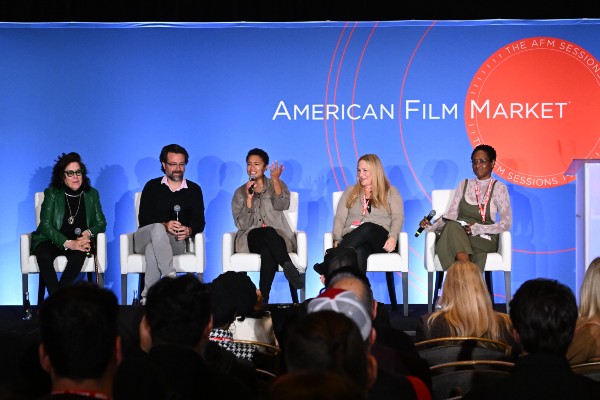
Among the sessions was Producers: Reframing our Narrative Through Coalition & Connection, presented by Women Independent Producers (WIP, Women in Film, and Reframe. Panel discussion was moderated by Nigerian-American filmmaker Adetoro Makinde, executive director/president/co-founder of WIP. Producer panelist Deniese Davis, a four-time Emmy nominee (three for Outstanding Variety Sketch Series in recognition of A Black Lady Sketch Show; one for Outstanding Comedy Series on the strength of Insecure). talked of the often unheralded commitment that a producer has to have for a project in order to bring it to fruition. She recalled helping to develop and nurture a film which took seven years to see the light of day. Davis described such a commitment as “a moral contract you make with yourself,” way before you get an actual contract. In order to realize a film, a producer has to be deeply invested and must believe in the work. She affirmed you “have to love it, to be passionate”–and that is part of the foundation, the driving force needed to turn a creative vision into reality.
Producer panelist Monica Levinson quipped that in many respects there are no boundaries for producers, noting in that vein that she’s produced multiple Borat projects (including garnering a Producers Guild Award nomination for Borat Subsequent Moviefilm). On a more serious topic, Levinson shared that producers at times don’t get due credit, recalling hearing on occasion that “the creatives need to talk” as they break away from the producer. Clearly, she affirmed, producers are key creative contributors to content in all its forms.
When moderator Makinde asked panelists to select a song that reflects what a producer does, Carol Ann Shine immediately responded, “I Work Hard For The Money.” She added that it’s the producer who often provides “the will for a movie to get made.”
And asked what producing hill he would die on in terms of what he most fervently believes he needs to preserve and protect, producer panelist Matthew Miller immediately affirmed “crew safety,” making sure everyone can get home safely, be with their families and come back to work the next day. That for him is an nonnegotiable priority.
Another AFM highlight was its 12th annual Pitch Conference which on Saturday (11/15) reunited award-winning producer Cassian Elwes and screenwriting professor and coach Lee Jessup, who were joined this year by independent producer Loni Rodgers. From more than 150 video pitches submitted, 20 pre-selected participants were invited to pitch live on stage, where the judges provided constructive feedback and awarded director Paul Andersen of Australia top honors for his family comedy feature Disconnect (written by Joey Day Hargrove)–about a dysfunctional family that must learn to work together when aliens invade their town through their screens.