
Moderating an awards season panel discussion right after a recent screening of Sinners (Warner Bros. Pictures) at the Directors Guild in Los Angeles, Spike Jonze observed that writer-director Ryan Coogler’s film is several movies rolled into one, blending genres such as horror, musical, drama, big-screen spectacle and period piece. Jonze expressed his admiration for Sinners directly to Coogler and several other panelists who contributed to the film.
Coogler later told SHOOT that he wanted “to make something from the heart,” describing Sinners as “a stew of a movie,” quipping that he should have called it “Gumbo.”
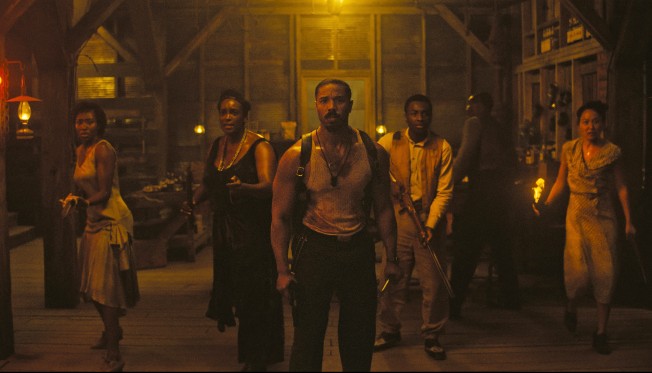
Sinners introduces us to street-smart twins Smoke and Stack (portrayed by Michael B. Jordan) who return home to the Mississippi Delta–after making major coin working for the mob in Chicago. Looking to go into business for themselves, Smoke and Stack convert a sawmill (brought from a racist landowner) into a juke joint where the locals can unwind with food, drink and inspired blues music. The twins recruit their young cousin Sammie (Miles Caton), a self-taught, talented blues guitarist, and Delta Slim (Delroy Lindo), a veteran pianist, as marquee performers. Smoke’s estranged wife Annie (Wunmi Mosaku), a Hoodoo practitioner and spiritualist, is brought on as the cook, while Chinese shopkeepers Grace (Li Jun Li) and Bo (Yao), a married couple, are key suppliers (including handling some sign making) for the business. We see these and other elements fall into place–such as Stack reconnecting with his former girlfriend Mary (Hailee Steinfeld)–during the course of a fateful day, extending into a brutal, terror-filled night when a clan of vampires–led by the ruthless yet strangely charming Remmick (Jack O’Connell)–infiltrate the community, turning the juke joint into a chamber of horrors.
Helping to coalesce this ingenious, heartfelt gumbo of different genres is a substantive societal narrative. For example, the period piece aspect of the film presents us with a slice of history chronicling the racially segregated South during the Jim Crow era. A journey through vampire folklore at the same time uncovers the real-world horrors of racism and oppression. And it’s the humanity at the heart of the story that drives the film. A key visual reference which Coogler shared with cinematographer Autumn Durald Arkapaw, ASC to reflect that humanity was the still photography of Eudora Welty in 1930s’ Mississippi. Welty made her first mark as a photographer before going on to become an accomplished author. Coogler cited her photography as a visual inspiration for what he wanted to capture in Sinners, reflecting the Black experience in that era–and the humanity of a populace that was given short shrift in the public eye.
Robert MacNeil, the late journalist known for his tenure on PBS, including co-anchoring The MacNeil/Lehrer Report and The MacNeil/Lehrer NewsHour with Jim Lehrer, was a friend of Welty. MacNeil observed that Welty’s images from the ‘30s chronicled a richly beautiful and caring Black America culture that was otherwise invisible in mainstream society. It was the humanity and spontaneity of those pictures that Coogler shared with Durald Arkapaw as visual guidance and inspiration for Sinners. Grounded in relatable humanity, the work of Coogler and Durald Arkapaw gives Sinners an eloquent resonance.
Coogler recalled that he found Welty’s photography at a used bookstore right around the time he was working on the Sinners screenplay. Welty, he said, clearly had earned the trust of her subjects as she photographed them simply being who they are–an image of a woman seated on a porch, her chin resting in her palms, is among those that made a profound impression on Coogler. He saw and felt a modern relevance to the photography–as he did to the blues music of the era. And he sought to bring that to Sinners, underscoring that this history has impacted us, can still be felt and is meaningful now, helping to shed light on life today.
Coogler hearkened back to his uncle who introduced him to blues music, periodically playing vintage records. Since his uncle’s passing, Coogler fell deeper in love with that music and through it felt his uncle’s spirit. Coogler wanted to capture that spirit, that haunting, inspiring music and mesh it with his love for horror cinema, mystery and in a sense reintroduce himself to audiences, sharing something different with them after making an initial directorial splash with the critically acclaimed Fruitvale Station done on a shoestring budget and then major releases such as Creed, and the tentpole successes Black Panther and Black Panther: Wakanda Forever. Along the way Coogler picked up a pair of Oscar nominations–as a producer for the Best Picture-nominated Judas and the Black Messiah (shared with Shaka King and Charles D. King), and for Best Original Song for “Lift Me Up” (shared with Tems, Rihanna and Ludwig Göransson) from Black Panther: Wakanda Forever.
Essential to all of Coogler’s work is the ensemble–or more accurately, the family–of collaborators he assembles, artists with whom he shares a shorthand, including participants in the earlier alluded to session moderated by filmmaker Jonze–such as producer Sev Ohanian, composer Göransson, editor Michael P. Shawver and DP Durald Arkapaw. Furthermore, past and present family members contribute to growing that family. Coogler, for instance, formed a special bond with cinematographer Rachel Morrison, ASC spanning Fruitvale Station and Black Panther. She was having her first baby which precluded her from lensing Creed in-between those two features so Coogler connected with DP Bradford Young, ASC for Creed. Morrison later also wasn’t available for Black Panther: Wakanda Forever in that she had moved into directing, which ultimately yielded her well-received feature helming debut, The Fire Inside. Both Morrison and Young recommended Durald Arkapaw to Coogler for Black Panther: Wakanda Forever. Coogler was drawn to Durald Arkapaw’s work, noting that she was no stranger to the Marvel universe, having shot Loki (which earned her a primetime Emmy nomination). Coogler and Durald Arkapaw have since built a strong rapport extending from Black Panther: Wakanda Forever to Sinners.
In SHOOT’s Road To Oscar Preview back in October 2025, Durald Arkapaw noted that the complexities and highly ambitious nature of Coogler’s work can be daunting–but such challenges are less so because of the writer-director’s brilliance in assembling an ensemble of artists and problem solvers who care for one another. “I feel fortunate to make a film like this on that scale with people I consider to be family and friends,” said Durald Arkapaw, noting that Coogler creates this collaborative culture with people who “enjoy making films with each other. People respond to that. Audiences feel that,” she affirmed.
With the collaborative support of Coogler, Durald Arkapaw also made cinematic history on Sinners, becoming the first woman to shoot a feature on large format IMAX film. It’s a distinction she’s embraced and is proud of, hoping that the next generation of aspiring female cinematographers–including those of color–will find inspiration in that milestone.
Coogler meanwhile finds inspiration in how audiences have responded to Sinners. The film, he observed, showed him the value of “putting yourself out there in a way that’s kind of holistic.” To then see audiences “accept the film, take it on and claim it on their own is really fascinating. It’s an experience I wish for all artists.”
Joseph Kosinski
Director Joseph Kosinski has long had a soft spot for racing films, drawn to such work as Le Mans (directed by Lee H. Katzin and John Sturges) and Grand Prix (directed by John Frankenheimer). Kosinski came close to taking on an automotive racing feature with the then-titled Go Like Hell but couldn’t get it made at the time–it eventually became Ford v. Ferrari and later got off the ground under the direction of James Mangold.
Kosinski’s interest in the racing discipline was rekindled during the pandemic when he watched the first season of Netflix’s Formula 1: Drive to Survive documentary series. The behind-the-scenes look at the F1 world focused on the drama, rivalries and struggles of mid-tier teams, providing a narrative which delved into the human stories of drivers grappling with personal and professional challenges.
He too wanted to tell a people-centric story–while also doing justice to the visceral experience of being in the driver’s seat of a Formula 1 racecar. Kosinski was uniquely qualified for this cinematic challenge, having captured the humanity and adrenaline rush of the fighter jet pilot. His Top Gun: Maverick put movie-goers in the cockpit of a fighter jet like never before, and earned Kosinski a DGA Award nomination.
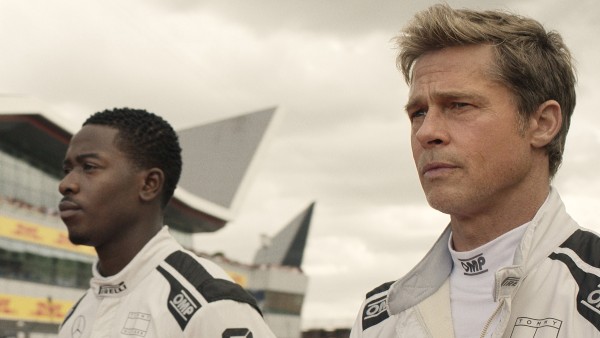
Fast-forward to F1 (Apple Original Films) starring Brad Pitt as Sonny Hayes, a hotshot driver back in the day who flamed out of Formula 1. He had since gotten behind the wheel of assorted vehicles in other driving circuits, continuing to race. Hayes is approached by a friend from the past, Ruben Cervantes (Javier Bardem), about returning to Formula 1 racing and helping out his fledging team, APX. Hayes turns him down at first but eventually comes aboard–meeting, confronting, butting heads and finally coming together with rookie driver Noah Pearce (Damson Idris) who’s arguably as much of a hotshot as Hayes was originally.
Of paramount importance to Kosinski was to tell a story “anyone would want to go see” regardless if they had an affinity for automotive racing. Kosinski embraced the idea of Pitt–whom he always wanted to work with–playing “a phenom who burned out early,” seemingly never to be heard from again. What evolves is a competition between two drivers–Pitt’s Hayes and Idris’ Pearce, with the former veteran racer trying to make his younger counterpart better.
At the same time, Kosinski and his long-time cinematographer, Claudio Miranda, ASC, sought to give viewers a true Formula 1 experience. Seven-time racing champ Lewis Hamilton, who was involved in the film early on, told Kosinski that he’d never seen a film that had really captured what it felt like to be in one of those cars. Kosinski, Miranda and Hamilton wanted to bring an unprecedented authenticity to that aspect of the story. The racing scenes had to be practically shot, and feel as grounded as possible. And thankfully, as in the past on such endeavors as Top Gun: Maverick–which Miranda also shot–Kosinski made every effort to carve out additional time so that he and the cinematographer could problem solve, weigh options together and prepare accordingly.
For F1, this included tasking Sony with developing a super-compact prototype camera, nicknamed Carmen. Panavision was also enlisted to manufacture custom compact pan-heads for Carmen. Thus Miranda’s goal of putting cameras onto cars and capturing full-speed action became a reality. Conventional heavier cameras were not an option, weighing down vehicles and making it impossible for them to reach breakneck speed. The need for speed sparked new technology and experimentation with different angles–as well as consulting with Mercedes about where mounts could be placed to get the desired effect. Carmen was part of a lineup for F1 which included Sony VENICE 2 digital cinema cameras, DJI Ronin 4D cameras, and Apple iPhone tech shrunken down to nimble packages. This all made it possible to lens largely on location, not having to resort to visual trickery entailing shooting of scenes with a car on a platform.
Kosinski and Miranda also take us into the high-tech world of Formula 1 beyond the cockpit. We meet, for instance, a support team assembled by Bardem’s character, Cervantes–including APX chief Kaspar Molinski (portrayed by Kim Bodnia) and technical director Kate McKenna (Kerry Condon)–who monitor the racing performances via state-of-the-art digital sensors connected throughout the cars.
And of course juxtaposed with the high speed dynamic are quieter human moments focusing on Pitt, Idris, Condon, Bardem and Bodnia. Miranda’s contributions were key in attaining this balancing act–a mesh of quiet and high-octane scenes, all done with a mix of tension, beauty and artistry.
Reflecting on the experience of making F1, Kosinski shared, “The standard rules of filmmaking are always reinforced. Casting is the most important thing a director does. Having a great crew around you, there’s no replacement for that.” But a new lesson learned, he continued, was the realization of “how much we can do in a very short amount of time. This idea of needing three days to shoot a scene to get the best version of it is not necessarily the case. When faced with extremely challenging limitations, with the right group around you, everyone can rise to the occasion and accomplish something. I’m looking forward to what I can do next. I’m not as fazed by a limited window of time.”
In this regard, Kosinski likened his F1 experience as akin to being part of “a cinematic pit crew,” being able to adapt on the fly in order to capture something that hadn’t been done previously. “There’s no way to fake the energy of a Formula 1 race.” You have to be very much like a Formula 1 team,” he said, in order to do so.
Helping immeasurably, added Kosinski, was Formula 1 accepting the cast and crew as another racing team on the circuit. Being part of that world made it easier to do justice to–and to create–that world in a movie.
(Editor’s note: Kosinski’s commercialmaking/branded content home is production house RESET, and he is an alum of SHOOT’s 2005 New Directors Showcase.)
Craig Brewer
Song Sung Blue (Focus Features) is in some respects a tale of two film festivals at opposite ends of the continuum in terms of their visibility. Written, directed and produced by Craig Brewer, Song Sung Blue made its world premiere as the closing night film of the high-profile AFI Fest back in October. But in order to land on the AFI Fest red carpet, Brewer years earlier made a fateful stop at a lesser known film festival in Memphis, Tenn. When attending this kind of indie fest, Brewer shared that he generally finds himself “trying to fill out my day with things to see,” often acting on a whim or hunch. A fan of Neil Diamond, Brewer decided to give Greg Kohs’ 2008 documentary Song Sung Blue a look-see. What unfolded before Brewer’s eyes was the alternately inspiring and tragic love story of Lighting and Thunder–a Milwaukee husband-and-wife singing duo consisting of Mike and Claire Sardina–whose act pays tribute to the music of Diamond.
The real-life narrative engrossed Brewer who said he thought at the time, “If I wrote it [as an original screenplay], someone would tell me I went too far. Everything that happened to this couple who just wanted to sing at bars and county fairs, entertain people locally” was hard to believe. But Brewer went on to not only delve into, fathom and process the story but believe in it as a narrative film. He connected with Kohs (who gained an exec producer credit) to bring to fruition what would become the film that wrapped the 39th edition of AFI Fest.
Aside from the relatively obscure festival circuit, recalled Brewer, the only way to see Kohs’ original documentary was to order it through him. Kohs would then burn a DVD and mail it to you. Brewer had screenings at his house of Kohs’ doc. and said that everyone who saw it, fell in love with it.
Brewer could relate as a filmmaker to what went into the making of Kohs’ documentary. Brewer made his feature directing debut with The Poor & Hungry, a black-and-white production carrying a budget of some $20,000. “There would be five people in the audience watching your movie,” he related. “That was what Greg Kohs’ documentary was…I luckily happened to be one of those five people in one of those audiences.”
Kohs has firmly established himself as an award-winning filmmaker. Similarly Brewer after The Poor & Hungry, wrote and directed his breakout feature Hustle & Flow, produced and financed by his late mentor, John Singleton. Hustle & Flow premiered at Sundance and earned an Oscar in 2006 for Three 6 Mafia’s “It’s Hard Out Here for a Pimp,” making them the first hip-hop group to win in the Original Song category. Terrence Howard also earned an Academy Award nomination for Best Leading Actor.
Brewer’s filmography over the years has on occasion had him adapting fiction and nonfiction books but Song Sung Blue was “trickier” in that he had to do justice to two uniquely real protagonists from a documentary, distilling 10 years of their lives into a two-hour movie. Helpful in that pursuit were talks with Claire Sardina, her son, daughter and step daughter who opened up their lives to Brewer, telling him stories about the family. Brewer added that Kohs was also supportive, coming to set and staying on all the way to the final edit. Kohs had dedicated years of his life to tell the story of the Sardinas. Brewer said that Kohs shared invaluable observations and details which helped him shape the screenplay.
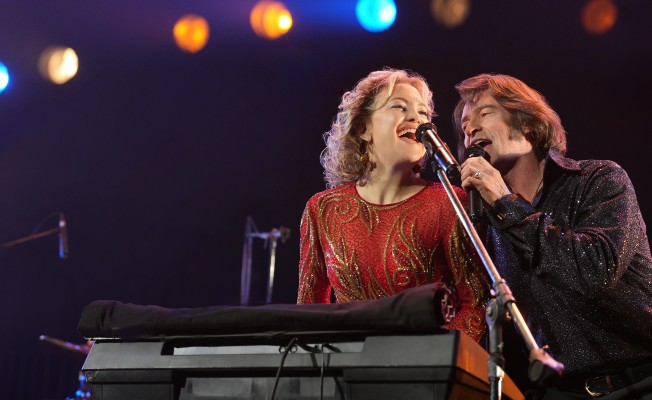
Essential to Brewer realizing his vision was the casting of Hugh Jackman and Kate Hudson who brought their acting and musical chops to the portrayals of Mike and Claire Sardina, characters who prove it’s never to late to find love and follow your dreams. So too did Brewer doggedly pursue Song Sung Blue–but the final film didn’t come together until much later than he had originally hoped. Despite a track record of feature film success with stories about underdogs, marginalized or overlooked people overcoming adversity, Brewer had a hard time generating interest in Song Sung Blue. Rejected by major studios which deemed the project as not being commercially viable. Brewer’s Song Sung Blue stayed on the backburner for years–until Focus Features stepped up to the plate. In ways that long wait was akin to what Lightning and Thunder went through, facing major obstacles but ultimately overcoming them to have their artistry as performers recognized.
Brewer hopes that Song Sung Blue will help other stories about everyday people–many of whom fall through society’s cracks–get made and find an audience.
Jackman and Hudson head a cast which also features Michael Imperioli, Ella Anderson, King Princess, Mustafa Shakir, Hudson Hensley, Fisher Stevens, and Jim Belushi.
Brewer’s prior credits include: the Southern blues fable Black Snake Moan starring Samuel L. Jackson, Christina Ricci and Justin Timberlake; the Netflix feature Dolemite Is My Name, which won the Critics Choice Award for Best Comedy and earned Eddie Murphy a Golden Globe nomination; then another film with Murphy, the long-anticipated sequel Coming 2 America; and Fight Night: The Million Dollar Heist for Peacock, starring Kevin Hart, Don Cheadle, Taraji Pl Henson, Jackson and Howard.
For Song Sung Blue, Brewer assembled a team of artisans which included such long-time collaborators as cinematographer Amy Vincent (Black Snake Moan, and Hustle & Flow), editor Billy Fox (Dolemite Is My Name, Hustle & Flow, Coming 2 America, and Black Snake Moan), and composer Scott Bowmar (Fight Night: The Million Dollar Heist, Hustle & Flow, and Dolemite Is My Name).
Fiona Crombie
Production designer Fiona Crombie is no stranger to awards season, earning an Academy Award nomination in 2019 for The Favourite, the Yorgos Lanthimos-directed film which also won her a BAFTA Film Award as well as a British Independent Film Award.
Now Crombie is again in the awards season conversation for Hamnet (Focus Features), her first collaboration with writer-director Chloé Zhao. Based on Maggie O’Farrell’s novel of the same title, Hamnet follows William Shakespeare (portrayed by Paul Mescal) who is in the throes of writing, striving to succeed and making sense of his life. He falls in love with Agnes (Jessie Buckley). They wed but their family is later devastated when their young son, Hamnet (Jacobi Jupe), dies from the plague. The experience of love, loss and deep grief bears, however, a creative silver lining, inspiring Shakespeare to write “Hamlet,” a masterpiece reaffirming the transcendent healing power of theater.
The ambitious film has Zhao once again wearing several hats–just as she did for Nomadland, for which in 2021 she won Best Picture and Director Oscars while being nominated for Best Adapted Screenplay and Best Achievement in Film Editing. Zhao served as director, executive producer, co-writer (with O’Farrell) and editor (with Affonso Goncalves, ACE) on Hamnet.
Crombie received the script for Hamnet through her agent. She had already read the book and was familiar with the story. Crombie was struck deeply by Zhao’s first draft, immediately feeling connected to the material. She met Zhao during an initial Zoom meeting and felt simpatico with her. The conversation helped lay an “essential” foundation, assessed Crombie who put together an array of images that articulated for her the journey of the film. Many of the ideas communicated held throughout, underscoring what Crombie felt–that her creative impulses and instincts aligned with those of Zhao.
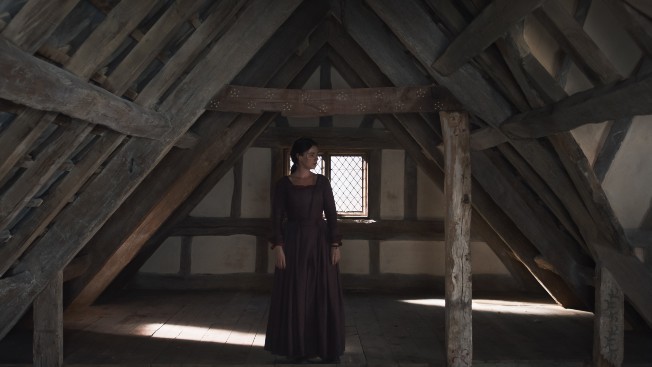
Crombie said of Zhao, “Authenticity is so crucial to her as an artist.” The production designer added that Zhao was committed to finding “the most truthful way to articulate that family” through where they lived and came from. Crombie and Zhao scouted all over England and Wales in search of the Shakespeare family home. Ultimately it became clear that the house had to be designed and built–but the scouting wasn’t for naught as Crombie retained details of the many homes she visited, incorporating a number of those nuanced elements into the set. She worked closely with her long-time colleague, set decorator Alice Felton–with whom she shared the Oscar nomination and BAFTA and Independent Film Awards for The Favourite–to do justice to a story of intimacy, human connection and loss. The period piece home could not feel like a museum piece. Rather it had to feel lived in, with a heartbeat. “To me that is very much about having unmade beds, evidence of activity, preparing food, peeling eggs, little things that actually do make up our lives. Our lives are made up of little moments that have this resonance.”
She noted that the house was over a century old by the time the family was living there. So the design had to reflect the history in that residence yet also feel alive. The set was built over nine weeks, with multiple layers of detail.
Crombie noted that she and Felton have worked together since 2013, developing “an incredible shorthand, a real creative partnership.” Crombie credited Felton with bringing a distinct “layering of depth and detail into the set decoration” while managing to always surprise her with an aspect or element that helps to advance the story and supports who the characters are.
This depth and detail were also integral to their creation of the legendary Globe Theater where Shakespeare’s plays came to life. Illustrations of the historic venue were of some help but they were largely of the exterior. There were no renderings of the interior. And The Globe was in some ways depicted to be larger than its London surroundings–as if to promote the theater as so magnificent that it overshadowed its environs. Crombie took some license in that the illustrations were of the “new” Globe–the original had burnt down, replaced with something more ornate and less intimate. She sought to create a Globe that was smaller (about 75 percent of what had been depicted) and had an intimacy that nurtured both the stories on stage and the audience experiencing them.
The Globe also had to be designed to accommodate the cinematography of Lukasz Zal, capturing the work on stage and the audience’s relation to it within the venue. The Globe had an inviting, organic, rustic feel. There’s a real connection to the natural power of art–and its ability to heal.
Crombie found Zhao to be deeply collaborative, engaging in a way with everyone that was “so generous.” It was like going on a journey together and making discoveries along the way as to how to best tell the story. Though Zhao had strong ideas as to what she wanted, she was also open to the ideas and contributions of others, giving her colleagues a feeling of having a meaningful hand in “sculpting the work,” a dynamic that “kept it alive for all of us.” Zhao had a standing invitation for cast and crew to bring, said Crombie, “our impulses and instincts,” which helps to make the work “really quite personal for all of us.”
Cara Brower
Hedda (Amazon MGM Studios) is the third feature from writer-director Nia DaCosta that production designer Cara Brower has worked on–the first two being the 2021 release Candyman followed by The Marvels in 2023.
Brower described their collaborative relationship as “a great pairing from the start,” noting that she and DaCosta have “similar tastes” and “aesthetically like the same things, the same kind of films.” Brower said that DaCosta taught her “to be even more open about watching everything.” The production designer explained that DaCosta goes to the movie theater every weekend and watches whatever’s playing. “It’s really refreshing to work with somebody who is so open [to new films and stories] and loves cinema so much.”
While DaCosta has a clear, well-defined vision, she wants people to bring ideas to the table. She not only has an openness to others’ thoughts and suggestions but also provides input and encouragement which serve as “a springboard” for her colleagues to think outside the box.
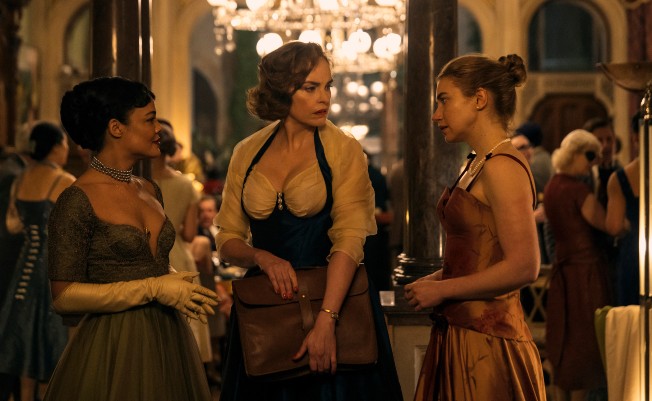
Hedda clearly resides outside the proverbial box as DaCosta takes Henrik Ibsen’s dramatic play “Hedda Gabler” and transports it from 19th century Norway to England in the 1950s. DaCosta’s Hedda stars Tessa Thompson in the title role of Gabler. Deliciously sinister, Gabler teams with her new husband George, played by Tom Bateman, to host a party at their sprawling mansion in a bid to advance his career. Over the course of an evening, Gabler masterfully manipulates her guests as the festivities are marked by biting wit and devious doings. Among the guests are Eileen Lovborg, portrayed by Nina Hoss, who has the inside track on the professorship coveted by George. Hoss is a woman who’s broken into the boy’s club with her intellect and talent–but she got bounced out after several public displays of drunkenness. Now, though, she is on the comeback trail, buoyed by the promise of a new manuscript she’s penned which should clinch a place for her. Adding to the tension between Hoss and Gabler is their past as lovers. Furthermore, Hoss has brought to the party her new lover, Thea Clifton (Imogen Poots). Gabler, though, is unperturbed, quick to take advantage by successfully tempting Hoss with alcohol and then absconding with her sole copy of the manuscript.
DaCosta’s adaptation of Ibsen centers largely on Gabler, Hoss and to a lesser extent, Clifton. The three women feel societal pressures and deal with them differently–with behavior that runs the gamut from inexcusable to noble.
Hedda debuted at the Toronto International Film Festival in September. Thompson and Hoss have gone on to score on the awards show circuit, garnering lead and supporting performance nominations, respectively, at the Film Independent Spirit Awards. Thompson won a special Spotlight Tribute honor at the Gotham Awards as well as a best lead performance nod. She additionally is a Golden Globe nominee.
Brower and DaCosta have crafted a modus operandi over the years which has the production designer creating a lookbook as a jumping off point. “Nine times out of 10 she will really respond to my initial thoughts,” shared Brower. “She tells me what doesn’t work or how she sees something if it’s not exactly the way I researched it.” From there, they embrace key concepts and take them to the next level, a process which Brower described as “fun.” Brower added that their experience together on The Marvels–an ambitious superhero film produced by Marvel Studios and distributed by Disney in 2023–proved vital. “It was such a bigger film than either of us had ever done. We grew a lot together.”
And that growth dovetailed nicely into Hedda with Brower embarking early on a quest to find the mansion where the evening party was to take place. Brower happened to be in the U.K. during re-shoots for The Marvels and had some extra time so she started searching for the Hedda house–which DaCosta described in great detail in her script, wanting a grand staircase, a library, a ballroom or large space with a balcony on the second level that you can look down from, a period kitchen and bathroom, and a lake she could see from the house. Ideally DaCosta wanted all this to be realized in one existing house that was situated within 45 minutes from London.
Brower knew this was a tall order but at the same time she appreciated the specificity in DaCosta’s description. Brower’s search worked its way out from London since so many homes in the city had been shot so frequently. Many of the country homes that might conceivably fit the bill, she added, are owned by the National Trust, meaning that they could not be modified in any way. And even privately owned homes had restrictions. Brower photo-scouted a couple of hundred homes but upon seeing them in person, ruled them out in a matter of minutes. Often such photos had been taken with wide-angle lenses, making homes appear larger than they actually were–and not up to the element of grandeur desired for Hedda. There were also intangible qualities which DaCosta deemed essential such as a feeling of mystery and playfulness in the architecture.
Brower had plenty of “big asks” for a historical home and wound up vetting some 200 houses. Still Brower was confident she could “thread the needle.” Her exhaustive search with the help of a location scout uncovered Flintham Hall in rural Nottinghamshire. She had a found a venue that met many of those “big asks” and was open to being modified on select fronts. For example, she related that there was no period kitchen on the premises–so one was constructed within the framework of the existing kitchen. An empty guest room with an appealing round window was converted into a period bathroom. A dining room was transformed into George’s study. Set decorator Stella Fox found perfect vintage library shelves which helped in that conversion.
Whereas Brower has a longstanding relationship with DaCosta, Hedda marked the production designer’s first time working with Fox. While there’s a comfort level in teaming with someone you’ve worked with before, Brower observed that there’s also great value in finding the perfect collaborator for a specific project. She wanted a set decorator who was “really bold, creative” and experienced in period films that had “constrained budgets like ours.” Brower was drawn to Fox, in part for the set decorator’s work on the 2020 release of Emma, directed by Autumn de Wilde and starring Anya Taylor Joy. Brower had been impressed by the deft touch Fox exhibited in that film set in England in the 1800s so she arranged a meeting with Fox. “We were on the same page as far as the look of the film,” said Brower, citing a shared desire to have Hedda emerge as “a different period film–fresh and not traditional.” Socialites of the time who departed from the norm were researched, their furniture helping to define their style and character. Brower loved connecting with Fox, finding her to be of “exquisite taste, very creative and passionate.”
Brower also was struck by Fox’s affinity for finding sculptural pieces from all over Europe that looked timeless, mirroring the backstory they had in their minds to bring a different dimension to Hedda.
The production design was also conceived and shaped with creative and practical consideration for the cinematography. Brower reunited with cinematographer Sean Bobbitt, BSC whom she had worked with on The Marvels. Bobbitt is both an Oscar and an ASC Award nominee for his cinematography on Judas and the Black Messiah and 12 Years a Slave, respectively.
“Sean is very collaborative. He loves seeing what we’re doing, sharing ideas of how he sees the lighting of the space,” said Brower, noting, for instance, that he was instrumental in helping her and Fox decide how to decorate Hedda Gabler’s bedroom in terms of color palette and how he would shoot it, conveying a cold, harsh feel.
Relative to her biggest takeaway from Hedda, Brower said she was “happy I stuck to my guns and took the time I wanted to look for that house.” She knew it would be hard but found it inspiring to work within the parameters and specifics sought by DaCosta. The production designer observed, “It kind of feels like a game, a puzzle I have to solve.” She appreciated the way DaCosta lets her collaborators “explore the aesthetic. That is really fun.”
Such exploration, particularly of assorted homes, enabled Brower to bring more to the house she ultimately used. For example she saw a little nook at one residence, sparking the idea for a 1950s’ telephone room which she brought to life at the Flintham Hall estate.
This is the eighth installment of SHOOT’s 16-part The Road To Oscar Series of feature stories. Shining a light on such disciplines as directing, cinematography, producing, editing, production design, visual effects and animation, this series will appear weekly all the way through to the Academy Awards gala ceremony. Nominations for the 98th Oscars will be announced on Thursday, January 22, 2026. The 98th Oscars will be held on Sunday, March 15, 2026, at the Dolby Theatre at Ovation Hollywood in Hollywood, Calif., televised live on ABC and streamed on Hulu.