

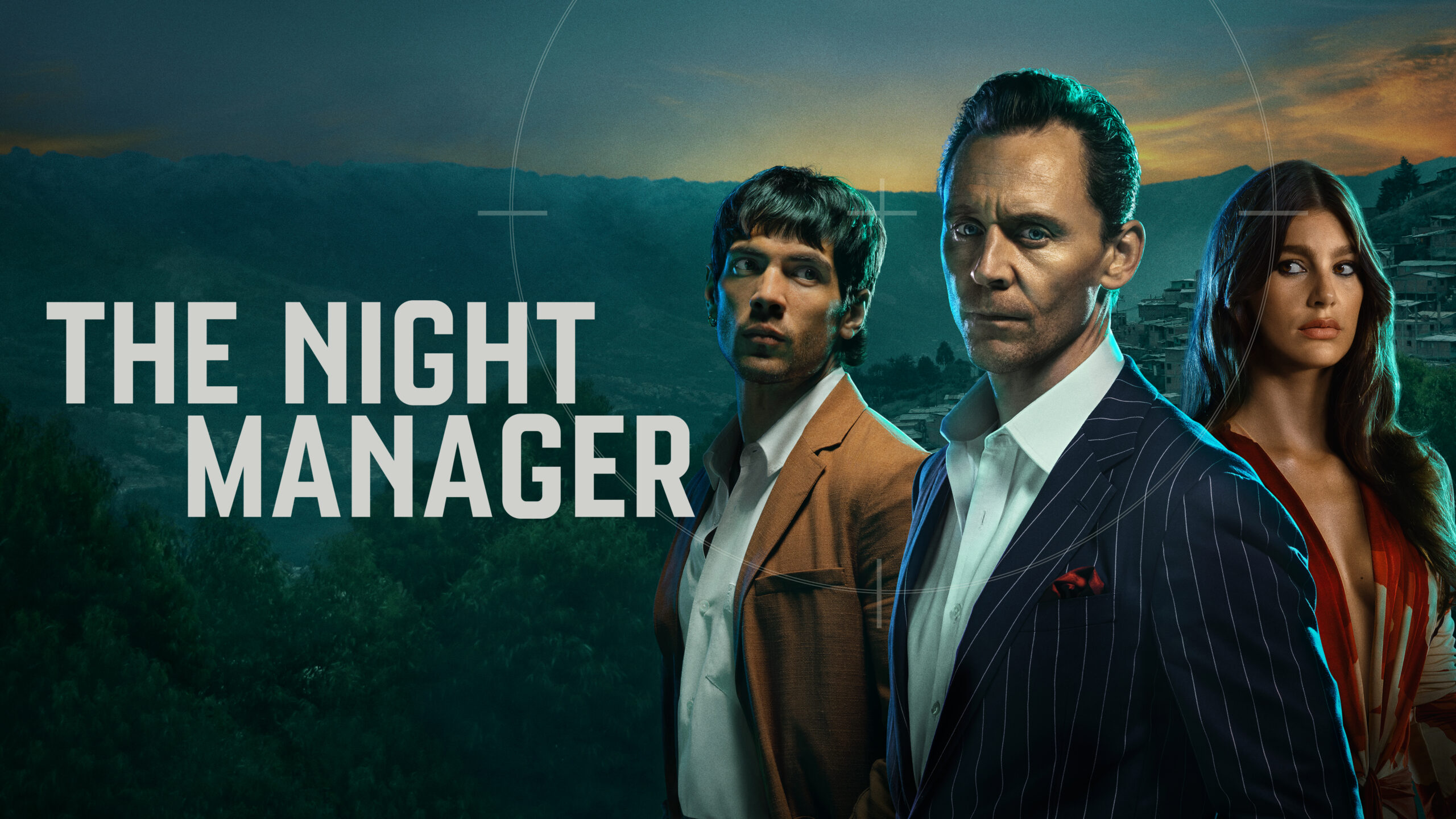

Your favorite Night Manager is back on duty this time in Colombia, but the shooting took place across London, Colombia, Spain, and Tenerife – creating logistical and creative challenges for the production designer Victor Molero, who not only had to design intricate sets but also often match exteriors and interiors of the same set across two continents.
In terms of shooting locations, season 2 spans across two continents. What was the timeline for prep and shooting, and how did you?
This new season was conceived as a truly international production, but from the outset, the challenge wasn’t simply where we were shooting; it was how to make those places feel like one coherent world. I joined the project through Stephen Garrett, with whom I’d previously collaborated on Culprits, and very early on we discussed how Spain could convincingly double for key Colombian locations once the production decided to base most of the shoot in Europe.
Research was absolutely fundamental. On every project, it is, but here it became the backbone of the work. Before making any creative decisions, we spent a long time understanding the specific identities of Cartagena, Medellín, and the jungle not as generic “locations,” but as lived-in environments. After extensive scouting in the UK, Colombia, and Spain, Barcelona and Tenerife became the pillars of the Spanish shoot, carefully mapped to those Colombian settings with the aim that transitions would be completely invisible to the audience.
At the same time, the real challenge was psychological as much as logistical. You have to approach a project like this with a mindset that allows you to constantly improvise while remaining absolutely consistent. Every location is a piece of a puzzle, and each decision – architectural, graphic, material, or tonal – has to support the same visual logic, even when the geography is fragmented. Authenticity lives in details audiences may never consciously notice, but would immediately feel if they were wrong: surface wear, local craftsmanship, color relationships, and how spaces are layered and aged. I approach other cultures with a great deal of respect, and not having prior personal experience in Colombia actually forced me to observe more carefully and question assumptions rather than rely on preconceptions.
Working closely with a Colombian art team was essential. They became a cultural anchor, helping us avoid clichés and ensuring the environments felt emotionally grounded rather than designed from a distance. We also made the decision to start in Colombia with a small group of key department heads who would later lead the longest phase of the shoot in Spain. Experiencing the culture firsthand meant they could internalize it, not just reference it. Ultimately, the success of the season came down to research, planning, and flexibility, understanding that production design is not only about creating spaces, but about making fragmented locations feel like one continuous, believable world.
Season 2 takes place in Colombia, but you shot some of the Colombian scenes in Tenerife and Spain. How did you create a believable Colombia in those places?
When I’m designing a culture that isn’t my own, believability starts with humility. I knew from the beginning that research alone wouldn’t be enough — it had to be paired with listening. That’s why working closely with Colombian artists and crew was essential. They became a constant reference point, challenging my assumptions and helping me avoid anything that felt simplified or second-hand.
Spain and Tenerife gave us a logistical solution, but Colombia came from collaboration and observation. I made a conscious decision to have key members of the art department travel across units, not only to protect continuity, but to carry visual memory with them, textures, proportions, graphic language, and small details that don’t always survive through reference images alone. That movement between units allowed me to stay close to reality while also taking full advantage of what each location was already offering us.
The real challenge was aligning very different places under one cultural logic while remaining flexible enough to respond to what I found on the ground. It’s a constant balance between control and openness — between design and discovery. When that balance works, the illusion holds, and the geography disappears. Some examples to illustrate this are that nature is not controlled or framed; it’s allowed to exist. In Colombia, trees interrupt sidewalks, façades, cables, and signage. The city bends around vegetation instead of erasing it, creating streets that feel porous and unpredictable. This relationship with nature reinforces the idea that spaces aren’t composed to be admired, but to be lived through, with constant overlaps between the organic and the built. Advertising is unapologetically direct. Alcohol ads are common and highly visible, integrated into everyday streets rather than separated into designated zones. They coexist with other messages instead of dominating them. At the same time, security advertising is increasingly prominent – alarms, surveillance, private security services – often layered over existing signage. It subtly communicates social reality without ever being stated. So I wanted to bring all of that to our locations set in Barcelona and Tenerife.
The show is ultimately about spies, deception, and facades. How did you show the mystery and the idea that people hide their identities in production design?
For me the series is fundamentally about identity and mistrust. Every major character operates under shifting identities, and no one can fully trust anyone else. I wanted the production design to express that idea spatially rather than through dialogue.
Roxana was conceived from the beginning as a transient figure, very much in line with the classic noir femme fatale — someone who never truly belongs to the spaces she occupies and is always one step ahead. For that reason, the production design functions as a kind of veil rather than an explanation: it doesn’t define who she is, it preserves her as a visual mystery. At the Bridcot Hotel in London, for example, I recreated the archetypal temporary lodging used to hide her, but allowed a red exterior neon to flood the room, visually contaminating the space and transforming an otherwise neutral interior into an extension of her danger and ambiguity.
As another example, in episode two, when Pine travels to Colombia and attends the gala at what we called the Golden Museum, the space becomes a visual clue for the audience. Inspired by Bogotá’s real Museo del Oro, and due to scheduling needs, the gala had to be recreated in Barcelona, using gold as a unifying material that felt culturally specific while also symbolically loaded.
My first idea was to collaborate with Colombian artists, but the production constraints made that impossible. Instead, we created the exhibition pieces from scratch with the help of Assaad Awad, ensuring that every object carried a clear intention. As Pine, Teddy, and Roxy meet there for the first time, the exhibition allows the characters to disappear into the space; at times, the artworks themselves create the illusion of masks crossing their faces, reinforcing the idea that identity in this world is performative and unstable. I used the Golden Museum gala as a spatial metaphor, a place where characters literally hide behind beauty, reflection, and gold, long before the story confirms they cannot be trusted.
The show features gorgeous mansions. Can you walk us through how you approached curating them?
I approached the mansions as psychological portraits rather than displays of wealth. There were two key houses, and although both are spectacular, they needed to communicate very different inner lives.
Teddy’s house, high in the hills of Medellín, was about restraint. The location itself was extraordinary – expansive views, expensive architecture – but the real challenge was asking how to strip all that back. Teddy is dangerous because he is a tortured character, marked by a childhood in which he was abandoned in a convent and raised under the Catholic faith, so his relationship with space is minimal and almost ascetic. We treated the house as austere, clean, and slightly clinical, filled with religious references and Colombian artwork used with great restraint. In many ways, Teddy and Pine live in parallel worlds, both in austere environments, but for very different moral and emotional reasons.
La Estancia, where Roper is hiding, was the opposite. The location was already powerful, but it needed a complete transformation. I leaned into the idea of a gilded cage. We painted dense vegetation directly onto the walls, not just as decoration, but as a metaphor. Roper is hiding from something unseen, surrounded by beauty that slowly becomes oppressive. The house is opulent, but it’s also a prison.
Crucially, this wasn’t meant to feel like a home. Unlike the Mallorca mansion in season one, La Estancia is not a reflection of Roper’s taste or power. It’s a place he’s been put in, a holding space created by others. Roper is supposed to be dead, and so is the fantasy version of himself we knew before. The mansion had to reflect that loss of control.
What were some of your other favorite aspects of working on season 2 that we might have not mentioned?
One of my favorite aspects of season two was the level of trust and collaboration across departments, particularly with our brilliant director Georgi Banks-Davies and the DoP Tim Sidell. From very early on, we developed a shared visual language, and that made the entire shoot feel unusually fluid. Decisions could be made quickly and protected, even as logistics shifted and locations changed.
Season two was a constantly moving puzzle — multiple countries, overlapping units, locations doubling for others — and what made it work was that sense of alignment. There was a real openness to conversation and adjustment, where planning and improvisation supported each other rather than competing. When that kind of collaboration is in place, the process almost feels effortless — and on a production of this scale, that’s something quite rare.