

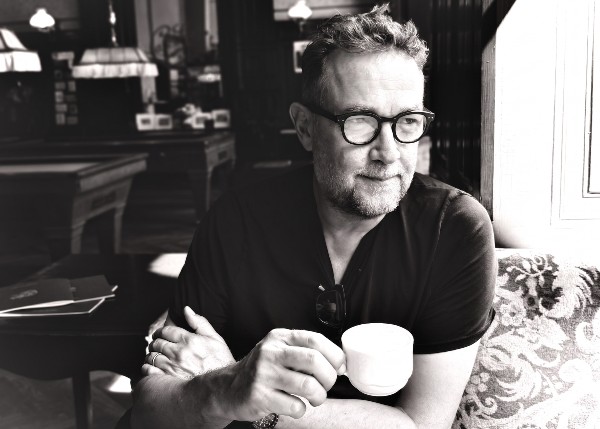
Phedon Papamichael, ASC, GSC is perhaps best known as a cinematographer, underscored by a pair of Oscar nominations–one in 2014 for his lensing of Nebraska for director Alexander Payne; the other in 2021 for The Trial of the Chicago 7 from writer-director Aaron Sorkin. Papamichael also is a two-time BAFTA Film Award nominee for his shooting of Nebraska and director James Mangold’s Ford v. Ferrari.
Still, in the midst of his ongoing, lauded cinematography–which includes an ASC Award nomination last year for Mangold’s A Complete Unknown–Papamichael not only has a track record as a director but is growing a bit deeper into that role, notably with work in commercials via IndependentMedia, the longstanding shop headed by executive producer Susanne Preissler.
His recent directing endeavors on the ad front (which often include him shooting the work as well) span such brands and agencies as Cadillac for 72andSunny, Volkswagen for adam&eveDDB in London, Laughing Man Coffee for Red Tettemer O’Connell + Partners, Nescafe for Publicis, Mercedes-Benz out of Publicis Berlin, a client-direct project for Fuji, and Hyundai for the European and Asian markets. This adds to a body of directorial work for Papamichael over the years which includes his helming debut on the mystery-thriller The Sketch Artist starring Drew Barrymore, the psychological horror feature From Within, which premiered at the Tribeca Festival, Arcadia Lost starring Nick Nolte, and the short A Beautiful Day starring James Brolin. Papamichael also teamed with Harry Patramanis to direct the documentary Through Children’s Eyes.
Papamichael noted that his work in commercials has informed his features–and that the feature directors he’s bonded with over the years have imparted lessons that he’s applied to his directing of commercials and other projects. For example Papamichael related that he learned from director Payne–for whom he shot not only Nebraska but also Sideways, The Descendants and Downsizing–”the simplicity of storytelling,” dating back to Sideways. This translated into “a simplicity of composition.” In fact, Papamichael recalled that his lensing of Nebraska impacted his directing of A Beautiful Day, varied commercials and other projects. Papamichael recalled that Payne “intentionally kept shots simple, never wanting to overpower any of the storytelling with flashy moves and lighting.” This approach by Payne reinforced what Papamichael experienced back when first establishing himself with work for producer-director Roger Corman. This simplicity was also underscored early on by Ingmar Bergman’s cinematographer, Sven Nykvist, whose work had a profound influence on Papamichael.
Besides A Complete Unknown and Ford v. Ferrari, Papamichael shot films for Mangold such as Walk the Line, 3:10 to Yuma, Identity, Knight and Day and Indiana Jones: The Dial of Destiny. Papamichael observed that he learned from Mangold the ability “to control the editorial pace.” Papamichael also cited Mangold’s blocking of shots, moving the camera in synchronicity with the actors. “He doesn’t make the audience feel manipulated or controlled,” explained Papamichael. “The worst thing for me is for someone to say that a movie looks great or incredible. It means I’ve failed.”
Papamichael added that for directors he works with like Mangold, it’s “important for a cinematographer to understand editing. If you are only a shooter, you sometimes lose out.” Papamichael explained that a pitfall of being just a shooter is falling in love with a long crane shot or an incredible dolly move. But once you have a perspective on the full process carrying through to postproduction, including the editing and mix, your choices as a cinematographer and director become of a big-picture nature. “You really come to appreciate how many things a director has to consider–the pacing, the rhythm, designing shots that work in the edit.” It’s been this big-picture perspective as a cinematographer which has positively affected Papamichael’s work as a director.
Both Mangold and Payne, continued Papamichael, are able to “react and take advantage of things not necessarily preconceived and storyboarded.” While Papamichael usually storyboards the commercials he directs, he frequently comes up with “10 angles and 10 shots” for every storyboard square drawn. Being able to consider multiple options and react to a moment or performance on set can make for a better film, do further justice to a story. “That language from independent filmmaking translates nicely into commercials,” he affirmed.
Papamichael’s collaborative relationships with filmmakers extend well beyond Payne and Mangold. On The Descendants, lead actor George Clooney saw first-hand the working relationship between Payne and Papamichael. Clooney was favorably impressed, so much so that he gravitated to Papamichael to shoot The Ides of March, which Clooney directed and starred in. Clooney served in the same dual role on The Monuments Men, and again turned to Papamichael.
Furthermore, Papamichael has shot multiple films for director Wim Wenders, including The Million Dollar Hotel, Willie Nelson at the Teatro, and Ode to Cologne: A Rock ’n Roll Film. Additionally, Papamichael has lensed international commercials directed by Wenders.
Papamichael noted that every experience and collaboration informs him and that this learning process has proved invaluable. He has also shot for such directors as Jon Turteltaub, Diane Keaton, Gore Verbinski, Oliver Stone, Nana Djordjadze, Brad Silberling, Gabriele Muccino, Judd Apatow, Christy Hall and Nick Cassavetes, among others. Papamichael has a bond with the Cassavetes family. His father teamed with Nick’s dad, director John Cassavetes, serving as production designer on such classic films as Faces and A Woman Under the Influence. And Phedon Papamichael even appeared in John Cassavetes’ 1976 film, The Killing of a Chinese Bookie.
Just as feature experience has informed his commercial directing, so too have ad endeavors impacted Papamichael’s overall filmmaking. For one, commercials keep him sharp in-between feature assignments, affording him the opportunity to work oftentimes with new innovative technology, as well as different collaborators and crews. On the latter score, he noted that commercials have as of late taken him to Japan, Canada, Hungary, Austria and France. “Crews in each of these countries have a slightly different approach,” said Papamichael who noted that their “little tricks and methods” are inspiring and informative, giving him the chance to borrow, if not, he quipped, “steal from everyone.” While he still regards Hollywood crews as the best in the world, it’s been enlightening to see how crews have developed internationally.
Also of substantive influence have been Papamichael’s roots. Born in Athens, Greece, Papamichael moved with his family to Munich where he completed his education in fine arts. Working as a photojournalist, Papamichael moved to New York and began to cross over into cinematography. Papamichael’s experience as a photojournalist carried over in terms of infusing his work with a realism and authenticity
Papamichael is a six-time ASC Award nominee. In addition to A Complete Unknown, he’s earned ASC nods for Nebraska, Ford v. Ferrari, The Trial of the Chicago 7, and a pair of TV productions, the miniseries Wild Palms and the telefilm White Dwarf.