

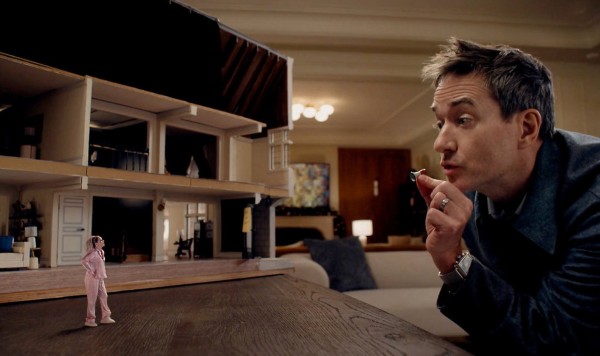
Visual effects house Zoic Studios delivered 563 shots across all 10 episodes of the Peacock series The Miniature Wife.
From the outset, the series presents a deceptively complex challenge. What begins as a relationship story quickly becomes a question of scale, with characters moving between a full-size environment and a miniature version of the same space. Unlike traditional visual effects work, this is not contained to a single sequence. The premise carries through every episode.
Based on the short story by Manuel Gonzales, The Miniature Wife is a dramedy that examines power imbalances within a marriage after a technological accident triggers an extreme shift in scale. As one partner adjusts to life at miniature size, the relationship is forced into unfamiliar territory.
At the center of the production is a dual-scale world that required precise coordination between production and visual effects from the earliest stages. Camera perspective, lensing, lighting, and spatial relationships all had to align so that interactions between characters at different scales would feel grounded and consistent.
“The challenge wasn’t a single moment,” said Dan Weir, VFX supervisor at Zoic Studios. “The established visual language that communicated Lindy’s miniature world and the interactions with the full sized world had to be consistent across the entire series..”
Several of Zoic’s shots are visible in Peacock’s behind-the-scenes featurette, including moments where Elizabeth Banks is swept away by water, climbs a vertical surface using suction cups, and reacts to failed experimental tests involving exploding corn. Additional shots show Matthew Macfadyen interacting with Banks’ miniature character, requiring precise alignment of performance and scale.
These moments point to the broader technical challenge at the center of the series: maintaining a believable interaction between full-scale and miniature worlds across an entire narrative.
Zoic played a central role in developing the visual language for these sequences, working as a creative partner in shaping how they would ultimately appear on screen.
“For the key sequences, we were involved early in shaping what those moments could be,” Weir said. “There wasn’t a reference point. We had to build it from the ground up.”
As the series progresses, the scope of the work expands to include more complex transformation sequences and a large-scale laboratory destruction rendered entirely in CG. The sequence layers debris, fire, smoke, and structural simulation to achieve a fully controlled cinematic result.
Zoic was one of the final three visual effects vendors on the project, taking on increased scope as production progressed. The team worked across multiple episodes concurrently, with a peak crew spanning compositing, lighting, and dynamics artists contributing to both visible and invisible effects.
Beyond the larger sequences, the work extends to subtle adjustments that support continuity throughout the show. Environmental changes, cleanup, and integration work ensure that the world remains consistent from scene to scene.
“What makes something like this work is consistency,” Weir added. “You’re asking the audience to accept a premise and then never question it.”
The Miniature Wife reflects a shift in how visual effects are used in long-form storytelling. Rather than building toward a single moment, the series depends on a sustained visual system that supports the narrative from beginning to end.
Zoic’s work sits within that system, helping establish a world where the premise holds across every frame.
The series stars Banks and Macfadyen, alongside O-T Fagbenle, Zoe Lister-Jones, Sian Clifford, and Sofia Rosinsky, with recurring appearances from Ronny Chieng, Aasif Mandvi, Rong Fu, and Tricia Black. Created by Jennifer Ames and Steve Turner, the series is produced by Media Res, with Greg Mottola directing select episodes.
All 10 episodes are now streaming exclusively on Peacock.
